Why Is Award Availability So Hard to Find?
Finding a flight with airline miles sounds like it should be simple….right?
An airline has an empty seat. You have miles. You search for the flight and use those miles to book it.
Except that’s often not what happens.
You might see plenty of seats available for cash but nothing available with miles. A flight that appeared yesterday can disappear today. One loyalty program might show an award while another doesn’t. And even when seats are available, the number of miles required can vary dramatically.
That’s because an empty seat and an available award seat aren’t necessarily the same thing.
Airlines control how, and sometimes whether, seats are made available through loyalty programs. Understanding that distinction explains much of what makes award travel frustrating.
TL;DR: Award availability can be difficult to find because airlines don’t necessarily make every unsold seat available for every type of mileage redemption. Availability can depend on demand, remaining inventory, the loyalty program you’re using, partner access and the airline’s award-pricing model. Flexible dates, routes and programs can dramatically increase your chances of finding a usable award.
What Is Award Availability?
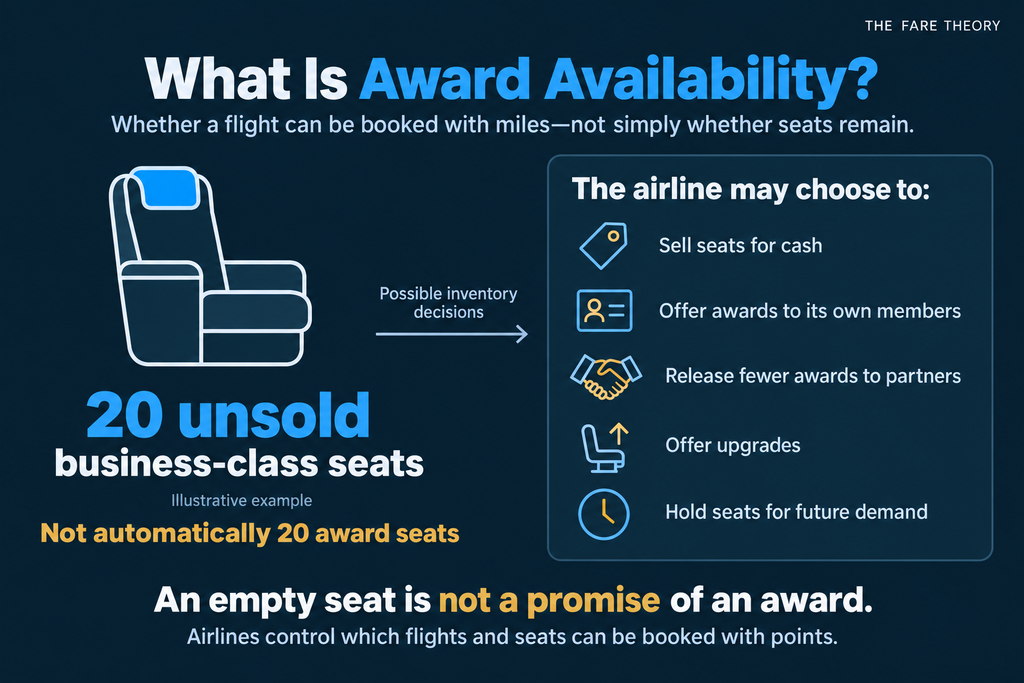
Award availability refers to whether an airline allows a particular flight to be booked using miles or points. That’s different from whether the flight has seats available.
Imagine a flight has 20 unsold business-class seats.
The airline could potentially:
- Sell those seats for cash
- Make some available to members of its own loyalty program
- Release a smaller number to partner programs
- Offer upgrades into those seats
- Hold the inventory and wait for higher-paying passengers
The fact that a seat hasn’t been sold doesn’t automatically mean the airline wants to make it available as an award. This is fundamental to understanding how award availability works.
Why Don’t Airlines Make Every Empty Seat Available With Miles?
The simple answer is that an airline seat is inventory with potential revenue attached to it.
Suppose a business-class seat could still sell for $4,000 before departure. Making that seat available through a mileage redemption may mean giving up the opportunity to sell it for cash.
The airline therefore has to make a decision:
What is the most valuable way to use this seat?
That decision can change as departure approaches. If bookings are strong, an airline may have little incentive to release additional award inventory. However, if bookings are weak, making more seats available to loyalty members may become more attractive.
This is closely related to airline revenue management, where airlines forecast demand and manage inventory to maximize the revenue generated by a flight.
But availability also depends on how you’re trying to book that seat.
Airlines can apply different rules to awards booked through their own loyalty programs versus partner airlines. For example, American Airlines’ AAdvantage terms and conditions explain that partner award seats may be subject to availability restrictions, while flights operated by American can require different mileage amounts depending on demand and availability.
That means a flight could have seats available for cash, offer an award through the operating airline’s loyalty program, and still have no award seats available through a partner program.
An empty seat doesn’t automatically mean an available award seat. And even when an award is available, the mileage price may not make it a worthwhile redemption.
Award Availability Isn’t the Same as Award Pricing
This distinction has become increasingly important.
Award availability asks:
Can I book this flight with miles?
Award pricing asks:
How many miles will it cost?
Historically, those questions were often more closely connected. Airlines could release a certain number of seats into specific award inventory, with relatively predictable mileage prices attached.
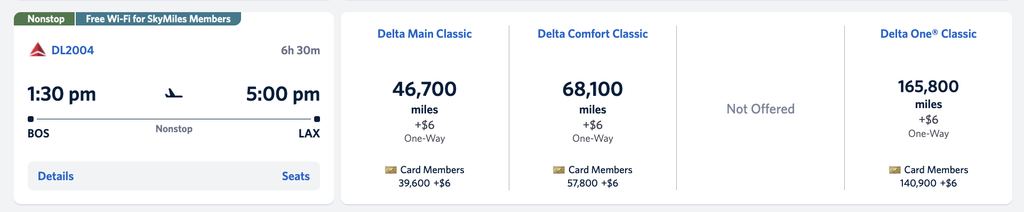
Dynamic award pricing can make things less straightforward.
An airline might allow you to redeem miles for nearly any available seat while changing the mileage requirement based on the flight, date or demand. So you could technically find plenty of “award availability”, but only at prices you would never seriously consider paying.
That’s why seeing a flight available for 180,000 miles isn’t necessarily the same thing as finding a good award redemption.
Why Can I Buy a Seat With Cash but Not Miles?
This is probably the most confusing part of award travel for beginners. You search an airline’s website and see:
- Business Class: 4 seats available
Then you select “Book with Miles.”…nothing. The airline isn’t contradicting itself. You’re looking at two different types of availability. The airline is willing to sell those seats.
It isn’t necessarily willing to make them available under the award conditions you’re searching for.
Think of the seat as an asset the airline can distribute through different channels. Cash tickets, upgrades, awards and partner awards can all compete for that inventory.
The airline doesn’t have to make every channel equally available.
Why Does Award Availability Disappear?
As many things in the aviation industry, broadly speaking availability isn’t permanent. Suppose an airline releases two business-class award seats 10 months before departure.
- You find them Monday.
- Someone books them Tuesday.
- You search Wednesday and they’re gone.
- Someone books them Tuesday.
But passenger bookings aren’t the only thing that can change. Airlines can adjust inventory as their expectations for the flight change.
If demand develops differently than forecast, additional award seats could appear, or previously available inventory could disappear. This is one reason award searching often requires flexibility rather than expecting a specific flight to remain available indefinitely.
Why Can Award Availability Reappear?
The reverse can happen too. A flight with no useful award seats today might suddenly have several next month.
Perhaps fewer passengers bought premium seats than expected. Maybe bookings slowed. Perhaps the airline changed how much inventory it was willing to release.
As departure gets closer, the airline gains more information about how the flight is actually selling. That doesn’t mean airlines always release unsold seats close to departure.
Some do it more frequently than others, and availability can vary dramatically by route, cabin, season and individual flight. But it explains why award searches aren’t necessarily one-and-done.
No availability today doesn’t guarantee no availability tomorrow.
Why Do Partner Airlines Make Award Availability Even More Complicated?
This is where award travel gets significantly more interesting.
Suppose United operates a flight from Newark to Frankfurt. United might make that flight bookable using its own MileagePlus miles. But that doesn’t necessarily mean the same seat will be available through every partner loyalty program.
Airlines can control what award inventory they make available to partners.
That creates two different questions:
Can the operating airline’s own members book the seat?
and
Has the airline made that seat available to partners?
Those aren’t always the same thing. This matters because partner programs can sometimes offer dramatically different redemption prices for the same flight.
Why Can One Loyalty Program Show a Flight When Another Doesn’t?
There are several possible reasons.
The operating airline may provide different inventory to its own members than it provides to partners. Programs can also have different booking rules, access to different partnerships and different ways of displaying award inventory.
This is why searching only one loyalty program can give you an incomplete picture.
A flight that doesn’t work with one type of miles might still be bookable through another program.
And sometimes the opposite problem occurs: a program appears to show availability that isn’t actually bookable.
That leads to another frustration in award travel.
What Is Phantom Award Availability?
Phantom award availability occurs when a loyalty program appears to show an award seat that can’t actually be booked.
- You find the perfect flight.
- The mileage price looks great.
- You transfer your points.
- Then the booking fails.
- You transfer your points.
- The mileage price looks great.
In some cases, the loyalty program’s website may be displaying inventory that isn’t actually available from the operating airline.
That’s why transferring flexible points before confirming that an award is genuinely bookable can be risky, especially because transfers to airline programs are generally difficult or impossible to reverse.
Why Are Business-Class Awards So Much Harder to Find?
Premium cabins combine two characteristics that make desirable awards particularly scarce:
There are fewer seats, and each seat can be extremely valuable.
An aircraft might have hundreds of economy seats but only a few dozen business-class seats.
Now add strong demand from:
- Cash passengers
- Corporate travelers
- Elite members seeking upgrades
- Travelers using miles
- Travelers booking through partner programs
Suddenly, the number of seats you’re competing for becomes much smaller.
This is also why award availability can vary enormously by aircraft. A route operated by an aircraft with 50 business-class seats creates a different inventory situation from one with 20.
You can learn more about why the operating aircraft matters in Does Aircraft Type Matter?
Does Booking Earlier Guarantee Better Award Availability?
The honest answer is no.vBooking early can help because many airlines open schedules roughly 10–12 months before departure, creating an opportunity to search when flights first become bookable.
But that doesn’t mean every airline releases its best award inventory immediately.vSome desirable awards appear when the schedule opens, while others appear sporadically.
Some become available relatively close to departure. And some flights may never offer attractive mileage availability at all.
So rather than thinking earlier = cheaper, it’s more useful to think earlier = more opportunities to start looking.
Flexibility Is the Biggest Advantage in Award Travel
The hardest award search looks something like this:
I need two business-class seats from Newark to Rome on June 14 on this specific flight.
You’ve constrained:
Origin + destination + date + cabin + number of seats + flight
Now compare that with:
I need two business-class seats from the Northeast U.S. to somewhere in Italy or nearby between June 12 and June 16.
Suddenly, you might be able to consider:
- JFK instead of EWR
- Milan instead of Rome
- Paris or Frankfurt with a connection
- June 13 instead of June 14
- Multiple airline programs
- Different operating carriers
Every constraint you can relax creates additional possibilities.
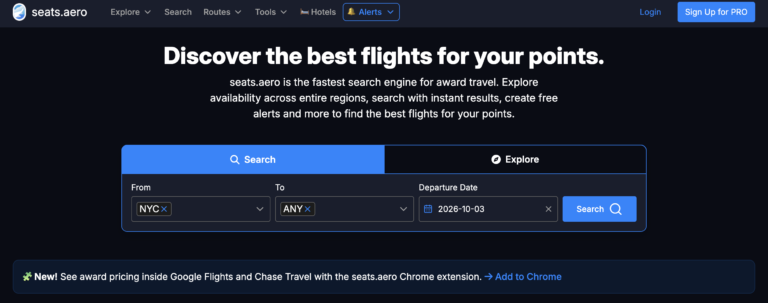
This is one reason tools such as Seats.aero can be useful: instead of repeatedly searching individual airline websites, you can explore award availability across broader combinations of dates, routes and programs.
Finding an Award Doesn’t Mean You Should Book It
Eventually, persistence pays off. Let’s say you find a business class flight, the dates work and you have enough miles…does that mean you should book it?
Not necessarily.
Availability answers whether you can redeem miles. It doesn’t answer whether you should. One should compare the mileage requirement with the cash fare, account for taxes and surcharges, and consider what else those miles could potentially buy.
That’s where When to Use Airline Miles: 4 Questions Before Redeeming becomes the next part of the decision.
Finding availability is only the first hurdle. Finding availability at a price that makes sense is what you’re really after.
The Fare Theory Take
Award availability feels unpredictable because travelers see an empty airline seat and naturally assume it should be available to book.
Airlines see something different.
They see inventory that could potentially be sold for cash, used for an upgrade, redeemed through their own loyalty program or made available to a partner.
Those possibilities don’t necessarily have equal value to the airline.
That’s why the best approach isn’t to memorize one perfect booking window. It’s to understand how award inventory works, search across multiple dates and programs, and remain flexible enough to take advantage when useful availability appears.
The goal isn’t simply to find an award seat.
It’s to find an award seat that works for your trip at a price worth paying.