

What Makes a Good Award Redemption? How to Know When to Use Miles
It’s easy to turn award travel into a math problem.
A flight costs $1,000. The airline wants 50,000 miles. Divide one by the other, calculate your cents-per-point value and decide whether that is a good award redemption.
There’s nothing inherently wrong with that approach.
But it leaves out something important: you’re not redeeming points in a spreadsheet. You’re trying to go somewhere.
A 100,000-mile business-class seat that produces an incredible theoretical valuation isn’t particularly useful if it’s available on Tuesday and you need to travel Friday.
Likewise, a redemption producing a more modest valuation could be extremely useful if the alternative is paying an unusually high cash fare for the exact flight you need.
Understanding when to use miles for flights therefore requires looking beyond the headline redemption value.
You need to consider the award price, cash price, availability, taxes and fees, flexibility and, perhaps most importantly, whether the redemption solves an actual travel problem.
Start With Award Availability
Before calculating anything, there’s a much simpler question:
Can you actually book the flight with miles?
Award availability is one of the biggest constraints in award travel.
Airlines don’t necessarily make every seat available at their lowest award price. Some programs use dynamic award pricing, while others release limited inventory to their own members or partner airlines.
That means the award you see discussed online may technically exist without being available for your trip.
Knowing how to find award availability therefore matters almost as much as knowing how to redeem airline miles. Start by searching the airline’s own website for your desired route and date. Then consider:
- Searching nearby dates
- Checking alternative airports
- Looking at nonstop and connecting itineraries
- Comparing the airline’s program with partner programs
- Checking different cabin classes
If your schedule is flexible, you may have significantly more options. However, if your schedule isn’t flexible, the value of the award seats that are available can increase considerably.
This is one reason award availability should come before obsessing over theoretical points valuations.

Compare the Award Price With the Cash Fare
Once you’ve found an available award, compare it with what you’d otherwise pay.
Suppose a flight costs $800 if you were to pay cash or could pay 40,000 miles + $5.60. At a basic level, you’re receiving roughly two cents of value per mile.
But now consider another flight where the cash fare is $250 or the award fare is 30,000 miles + $5.60.
The second redemption requires only 10,000 fewer miles despite the cash ticket costing $550 less.
Assuming everything else is equal, paying cash for the second flight and saving the miles could make considerably more sense.
This is the fundamental idea behind deciding when to use miles for flights: miles have an opportunity cost.
Once they’re gone, you can’t use them for another trip.
Don’t Let Cents Per Point Make the Decision for You
Cents per point, or CPP, is useful because it creates a common measurement for comparing redemptions.
But it has a major weakness.
Retail price isn’t necessarily the same thing as personal value.
Imagine you find an international business-class ticket selling for $5,000 or 80,000 miles. That’s more than six cents per mile before accounting for taxes and fees.
On paper, that’s an exceptional redemption. But suppose you would never spend $5,000 on that ticket. If the alternative was a $700 economy ticket, claiming that you “saved $5,000” exaggerates the financial value you actually received.
- You still may have booked an excellent award.
- You gained a substantially better experience without spending thousands of dollars.
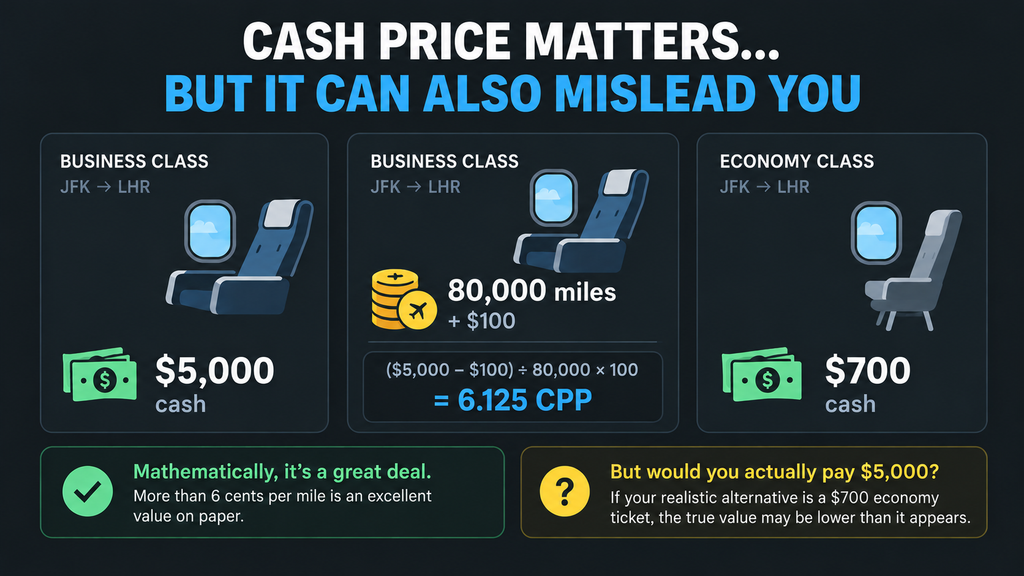
But that’s different from literally saving $5,000. This distinction is central to understanding what makes a good award redemption.
The best redemption doesn’t necessarily produce the biggest number. It produces value that matters to you.
Taxes and Fees Can Change the Equation
Mileage prices aren’t the only cost associated with award tickets. Some awards carry minimal taxes. Others can include hundreds of dollars in taxes, surcharges or other fees.
Consider two hypothetical business-class awards:
Option A: 60,000 miles + $650
Option B: 75,000 miles + $75
Option A initially looks cheaper because it requires 15,000 fewer miles, but you’re effectively spending an additional $575 in cash to save those miles.
Whether that’s worthwhile depends on how much you value the additional 15,000 miles.
This is why you should always compare the total cost of an award, not simply the number displayed next to the mileage symbol.

Flexibility Can Be Part of the Value
Award tickets can sometimes offer another advantage that CPP calculations struggle to capture…flexibility.
Depending on the airline and program, an award may have favorable cancellation or redeposit rules compared with the cash ticket you would otherwise purchase.
That can be especially useful when booking speculative travel far in advance.
Imagine you’re choosing between:
- A $700 cash ticket with restrictive cancellation rules
- 45,000 miles that can be redeposited relatively easily
Even if the mathematical valuation isn’t extraordinary, the ability to change your plans could make the award more useful.
Always check the specific program’s current rules before booking because award policies vary substantially between airlines.
When Should You Use Miles for Flights?
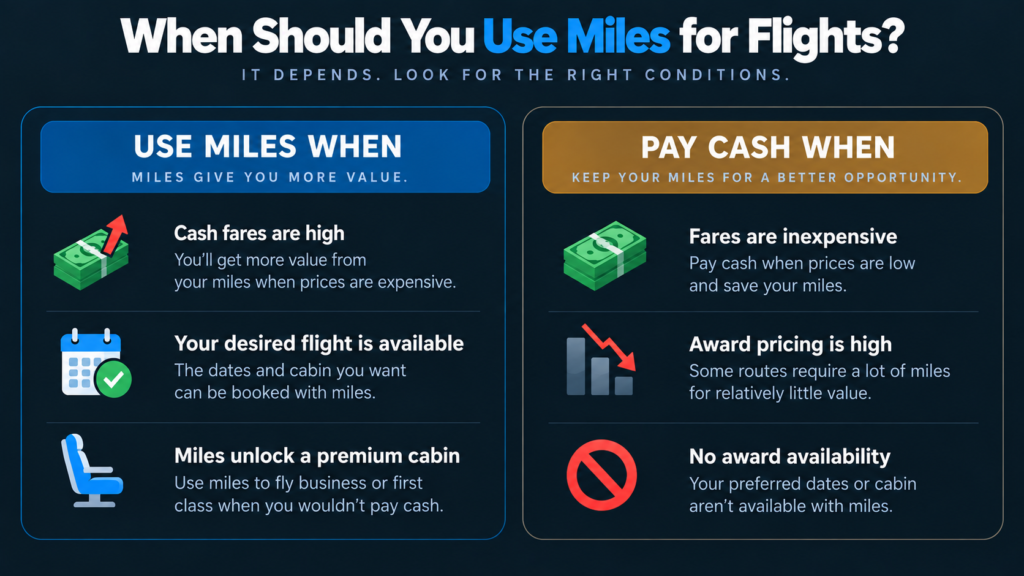
There isn’t one universal threshold, but miles become particularly compelling when several favorable conditions occur simultaneously.
Consider using miles when:
- Cash fares are unusually expensive
- Award pricing is reasonable
- The flight you actually want has award availability
- Taxes and surcharges are relatively low
- Miles unlock a premium cabin you wouldn’t otherwise purchase
- The award provides useful cancellation flexibility
- Using miles preserves cash for something more important
Conversely, paying cash can make more sense when fares are inexpensive, award prices are unusually high or redeeming miles would drain a large portion of your balance for relatively little benefit.
This is also why blanket rules such as “never redeem below two cents per point” aren’t particularly useful.
Your situation matters.
How to Redeem Airline Miles Without Wasting Them
A simple framework can prevent most poor redemptions.
Before transferring points or clicking “book,” ask yourself:
1. Is the flight I actually want available?
Don’t choose a terrible itinerary solely because it produces a better CPP.
2. What would I realistically pay in cash?
Use the fare you’d actually purchase—not necessarily the most expensive equivalent ticket available.
3. How many miles does the award require?
Compare that with alternative dates, flights and programs when possible.
4. What are the taxes and fees?
A low mileage price can hide a significant cash component.
5. What am I giving up?
Miles spent today can’t fund another trip tomorrow.
6. Does the award improve my experience?
A redemption that turns an unaffordable premium cabin into an attainable one can provide meaningful value even when the spreadsheet isn’t perfect.
7. Does using miles make this trip easier to take?
This may be the most important question of all.
A Good Redemption Isn’t Always the Cheapest Redemption
One of the easiest traps in award travel is optimizing so aggressively that the points become the goal rather than the trip.
Maybe Airline A offers an award for 55,000 miles while Airline B wants 70,000.
The first option appears obviously better.
But what if Airline A requires two connections and adds six hours to the journey, while Airline B flies nonstop?
You’re effectively spending 15,000 additional miles to save six hours.
That’s no longer simply a points question.
It’s a value question.
And sometimes spending more points is rational.
[T1/T2 LINK → relevant Flight Value article]
Suggested anchor: how we think about the value of a flight
This principle becomes even more important for short trips, limited vacation time or complicated itineraries.
So, What Is a Good Airline Miles Redemption?
A good award redemption is one where the miles you spend create more value for you than preserving them for an unknown future trip.
Sometimes that means achieving an exceptional cents-per-point valuation.
Sometimes it means avoiding a $900 last-minute fare.
Sometimes it means booking business class for a trip you’ve wanted to take for years.
And sometimes it simply means getting home on the flight that fits your schedule.
There is nothing wrong with optimizing airline miles. Understanding award pricing, searching for award availability and comparing cash prices can dramatically improve how far your points take you.
But optimization should serve the trip—not the other way around.
The Fare Theory take: The question isn’t simply “How much are my miles worth?”
It’s:
“What are these miles allowing me to do?”
If the redemption gets you where you want to go, at a price you’re comfortable paying, while providing more value than the realistic alternatives, you’ve probably found a good redemption.