
What Is Airline Revenue Management? How Airlines Price Seats
What Is Airline Revenue Management? How Airlines Price Seats
If you’ve ever watched a flight cost $427 on Monday, $581 on Wednesday and then somehow fall back to $489 a few days later, you may have wondered what exactly the airline is doing.
- The aircraft didn’t change.
- The distance didn’t change.
- Your seat certainly didn’t become more expensive to operate overnight.
What changed was the airline’s willingness to sell that seat at a particular price.
Behind many of those decisions is airline revenue management, the systems airlines use to forecast demand, manage inventory and determine how many seats they’re willing to sell at different prices.
Why Do Airlines Need Revenue Management?
Airlines have an unusual inventory problem.
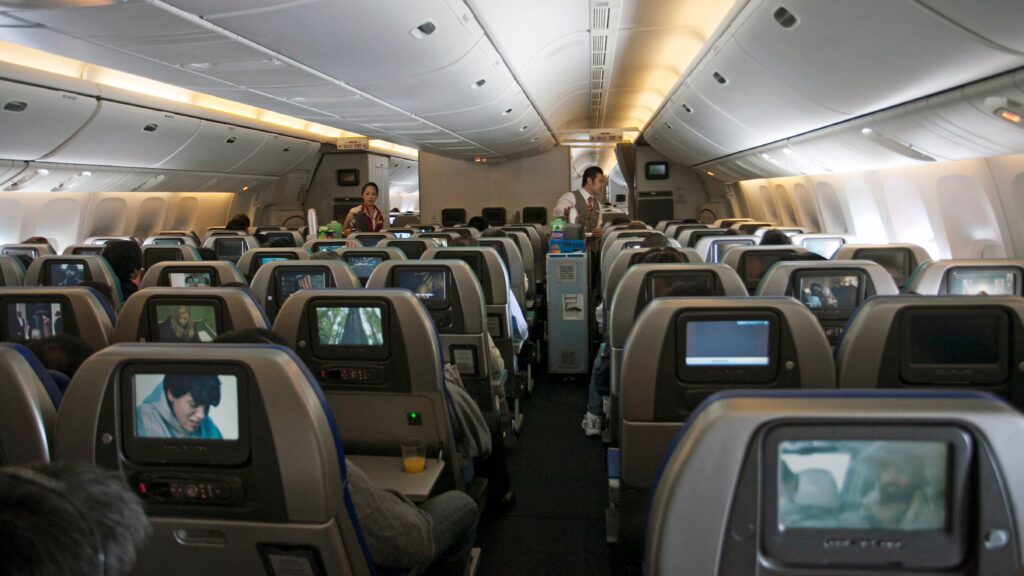
Imagine an airline operates a 250-seat flight from New York to London. Once that aircraft leaves New York, every empty seat instantly becomes worthless.
The airline can’t put seat 37A back on a shelf and sell it tomorrow. That specific opportunity to generate revenue is gone forever. But selling every seat as quickly as possible isn’t necessarily the answer either.
Suppose the airline opens reservations and immediately sells all 250 seats for $400.
The flight generates:
250 × $400 = $100,000
Sounds pretty good…except what if dozens of passengers would have willingly paid $700, $1,000 or even $1,500 closer to departure? While the airline filled the aircraft, they potentially left significant revenue on the table.
Now imagine the opposite.
The airline expects enormous demand and holds too much inventory for passengers willing to pay $1,000, but those passengers never materialize.
The aircraft leaves with empty seats.
Revenue management exists largely to balance those two risks:
- Sell too cheaply too early, and you sacrifice potential revenue.
- Hold out for too much money, and you risk flying empty seats.
How Airline Revenue Management Works
Airline pricing can look chaotic from the outside. However, behind the scenes, airlines are attempting to answer a fairly logical question:
How much inventory should we make available at different prices given the demand we expect for this flight?
Revenue management helps answer it using several interconnected processes.
1. Historical Booking Data
Airlines have enormous amounts of historical booking information. They can examine how similar flights performed based on factors such as:
- route
- departure time
- day of the week
- season
- holidays
- booking window
- historical demand
- passenger behavior
A Monday morning flight between two major business markets may behave very differently from a Saturday afternoon flight to a leisure destination.
Historical data gives the airline a starting point for understanding those differences.
2. Demand Forecasting
Historical information then helps airlines forecast future demand. Suppose an airline expects strong demand for a particular flight.
It may be less willing to make large amounts of its cheapest inventory available because its models suggest passengers willing to pay more will eventually arrive.
On a flight expected to experience weaker demand, protecting expensive inventory too aggressively could backfire.
The airline may instead make more lower-priced inventory available to stimulate bookings.
This is one reason understanding how airlines actually price flights is more complicated than simply looking at distance or the cost of operating the aircraft.
3. Inventory Management
Now we get to one of the most important parts.
A passenger might see an aircraft with 180 Economy seats and naturally assume the airline has 180 identical products to sell.
Operationally, those seats may look nearly identical. However, commercially, they don’t necessarily have to be sold the same way. Airlines can make inventory available through different booking classes associated with different fares and restrictions.
For example, an airline might initially make lower-priced inventory available at $349, and once that inventory is no longer available, the cheapest option might become $429. After that, it may be $519 and eventually $749.
That doesn’t necessarily mean the airline physically changed anything about the remaining seats. What changed is which inventory is currently available for purchase.
This is why understanding airline booking classes and fare classes is so important to understanding airfare.
4. Actual Bookings Begin Replacing Forecasts
Forecasting is only forecasting. But once people actually begin buying tickets, airlines gain new information.
Suppose a flight is selling considerably faster than expected. The airline’s systems can respond to that stronger demand by changing the inventory available at lower prices.
On the other hand, suppose bookings are coming in more slowly than expected. The airline may have reason to make cheaper inventory available again.
This helps explain something travelers frequently misunderstand: airfare doesn’t necessarily move in one direction. A fare disappearing today doesn’t guarantee prices will continue rising tomorrow.
In practice, airline revenue management is less of a one-time calculation and more of a continuous feedback loop:

Why Flight Prices Change Even When the Plane Isn’t Full
This is where airline revenue management becomes especially interesting for travelers. Imagine you’re watching a flight with plenty of available seats.
Yesterday it cost $450, but you search again and now it costs $620. It’s be easy to think “Oh, a bunch of people must have booked this flight”. In theory, that could be right, but that’s not necessarily what happened.
The number of physical seats remaining and the amount of inventory available at a particular fare aren’t exactly the same thing. The airline may still have plenty of seats to sell while no longer making its lowest-priced booking classes available.
Alternatively, its expectations about future demand may have changed.
That’s one reason flight prices can change even when a flight doesn’t appear to be filling rapidly.
And it’s why looking at a seat map and seeing dozens of empty seats doesn’t necessarily tell you whether a flight is actually lightly booked.
Why Two Passengers Can Pay Completely Different Prices
Revenue management also creates one of the strangest parts of commercial aviation, where two people sitting next together can pay vastly different prices.
- Same aircraft.
- Same cabin.
- Same meal.
- Same destination.
One paid $349 and the other paid $749. That doesn’t necessarily mean the second passenger got ripped off. They may simply have purchased their tickets when the airline was making different inventory available.
The first passenger might have booked months earlier when lower fare classes were open, whereas the second might have booked when only more expensive inventory remained.
This is part of a broader airline pricing strategy and is a real-world example of airline revenue management. And this is exactly one reason how two people can pay completely different prices for essentially the same airline seat.
While the physical product and experience may be nearly identical, the circumstances under which access to that product was sold were not.

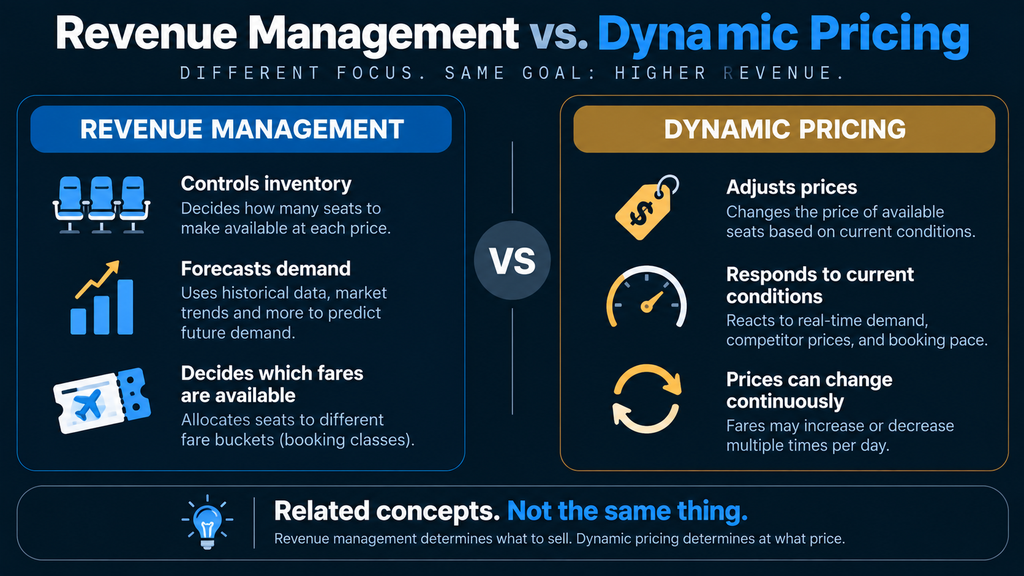
Revenue Management vs. Dynamic Pricing
Revenue management and dynamic pricing are related, but they aren’t necessarily the same thing. At the core of this analysis, revenue management is the broader discipline.
It includes things such as:
- forecasting demand
- controlling inventory
- analyzing booking behavior
- managing fare availability
- estimating future revenue opportunities
Dynamic pricing refers more specifically to prices changing in response to market conditions, demand and other information.
Modern airline pricing increasingly combines these concepts.
Instead of thinking about airfare as a static menu of prices, it can be more useful to think about airlines continually evaluating:
What should we be willing to sell this inventory for right now?
Revenue Management Also Helps Explain Overbooking
Price isn’t the only thing airlines forecast.They also care about whether passengers will actually show up.
Some passengers cancel their flights, while others will change their flights. On the other hand, some passengers will miss their connecting flights, while some simply don’t appear.
If an airline knows historically that a certain percentage of booked passengers won’t ultimately occupy their seats, accepting exactly the same number of reservations as physical seats could regularly leave the aircraft departing with empty inventory.
That’s part of the economics behind why airlines overbook flights. It’s another example of airlines using historical behavior and probability to manage an asset that becomes worthless the moment the aircraft departs.
Revenue Management Doesn’t Always Get It Right
It’s tempting to imagine airline pricing systems as all-knowing algorithms capable of predicting exactly what passengers will pay.
They aren’t.
Revenue management involves forecasting human behavior. And the reality is that humans aren’t perfectly predictable. There are so many variables that are ever-changing which could impact the airline’s strategy…
- An airline might expect a flight to experience significant last-minute demand that never appears.
- A competitor might change its schedule.
- Demand might suddenly weaken.
- Travel patterns might differ from historical expectations.
- The airline may have protected higher-priced inventory expecting customers who never materialize.
That’s one reason airfare can occasionally fall closer to departure even though conventional wisdom tells travelers that flights should become progressively more expensive.
Airlines aren’t necessarily following a predetermined staircase in their airline pricing strategy where ticket prices goes something like $400 → $500 → $600 → $700.
They’re continually responding to new information.
Airline Revenue Management Creates Pricing Opportunities
This can also create interesting opportunities for travelers. Revenue management occurs at the individual flight and market level. Two airports serving broadly similar destinations don’t necessarily experience identical demand.
For example, a flight from New York → Paris could cost $1,100, while a flight from Boston → Paris could cost $650. The Paris flight didn’t suddenly become $450 cheaper to operate from Boston.
The airlines may simply be responding to different competitive conditions and demand in each market. Travelers can sometimes take advantage of these discrepancies by using a positioning flight to begin a larger itinerary from another airport.
That doesn’t mean positioning is always worthwhile. Once additional airfare, hotels, baggage, connection risk and time are considered, the cheaper fare may not actually represent better value.
But it demonstrates something important:
Airfare is determined by markets, not simply miles flown.

Does Revenue Management Mean You Should Wait for Prices to Drop?
Not necessarily, and understanding revenue management doesn’t give travelers the ability to reliably predict what an airline’s system will do next.
A $500 fare could fall to $450, but it could also jump to $750 and never return. The more useful takeaway is recognizing what today’s airfare actually represents.
It’s not necessarily the permanent value of that seat…it’s the price associated with the inventory the airline is willing to sell at that moment. Trying to perfectly time airfare can easily become an exercise in waiting for information you don’t have.
What Airline Revenue Management Means for Travelers
Revenue management explains why one of the most common assumptions about airfare doesn’t really work:
The price of a ticket should reflect the cost of providing the flight.
Operating costs obviously matter to airline economics.
But the price offered to an individual passenger is also heavily influenced by demand, competition, available inventory and what the airline believes future customers may be willing to pay.
That’s why:
- A longer flight can cost less than a shorter flight.
- Two passengers can pay completely different prices for neighboring seats.
- A flight can become more expensive while many seats remain unsold.
- And a fare that disappeared yesterday can occasionally return tomorrow.
Once you understand revenue management, these outcomes stop looking quite as random.
The Fare Theory Take
Airlines don’t simply have a plane full of seats and attach one price to each cabin…they’re managing perishable inventory.
Every seat represents an opportunity to generate revenue, but that opportunity disappears forever when the aircraft door closes.
Sell too much inventory cheaply and the airline may sacrifice revenue from passengers willing to pay more. But hold too much inventory for expensive bookings and the plane may leave with empty seats.
Revenue management sits in the middle, and that leads to one of the most important ideas for understanding airfare:
The airline isn’t only asking what this seat is worth. It’s trying to predict what the next passenger might be willing to pay for it.