How Airlines Price Flights: The Economics Behind Airfare
Most people assume airlines price flights based on one simple factor: distance.
It sounds logical. A longer flight should cost more than a shorter one. After all, flying farther requires more fuel, more crew time, and more operating costs.
But if you’ve ever seen a nonstop flight to London cost less than a ticket to Florida, or watched airfare jump from $327 to $614 overnight, you’ve already discovered something important:
Airlines don’t price flights based on distance.
Instead, airlines use sophisticated forecasting models, pricing algorithms, and inventory management systems to determine what every seat should cost at any given moment.
The result is a constantly changing marketplace where two passengers sitting side by side may have paid hundreds, or even thousands, of dollars apart for exactly the same seat.
Understanding how airlines price flights isn’t just interesting. It’s one of the most valuable concepts a traveler can learn…
Once you understand the system, flight prices begin to make sense.
Airlines Don’t Sell Flights, They Sell Inventory
One of the biggest misconceptions in commercial aviation is that airlines sell transportation…they don’t.
They sell inventory.
Every flight is essentially a collection of perishable assets. Once an aircraft departs, every empty seat instantly becomes worthless.
Unlike a hotel room that can be sold tomorrow or a car that can remain on a dealership lot for months, an unsold airline seat disappears forever once the aircraft pushes back from the gate.
That creates a unique challenge.
Instead of asking:
“How can we sell every seat?”
Airlines ask:
“How can we maximize the revenue generated by every seat?”
Those are very different questions.
Selling every seat at the lowest possible fare might fill an airplane, but it doesn’t necessarily maximize profit. Instead, airlines attempt to sell the right seat to the right customer at the right price and at the right time.
That philosophy sits at the heart of modern airline revenue management.
Every Seat Is Not Equal
Imagine a Boeing 777 flying from Newark (EWR) to London Heathrow (LHR) with 250 economy seats. Most travelers assume those seats are sold at one price.
In reality, the airline may offer dozens of different prices for those same seats throughout the booking cycle.
Passengers sitting next to one another may have paid:
- $389
- $521
- $694
- $1,148
And every passenger receives:
- The same seat
- The same flight
- The same meal
- The same baggage allowance
Yet every passenger paid something different.
Why?
Because the airline wasn’t selling the seat. It was selling inventory availability based on changing demand. The price depended on factors such as:
- When the ticket was purchased
- Remaining seat inventory
- Expected future demand
- Competitor pricing
- Historical booking patterns
- Seasonal travel trends
In other words:
The value of a seat changes long before anyone sits in it.
What Are Fare Buckets?
One of the least understood concepts in airline pricing is the idea of fare buckets.
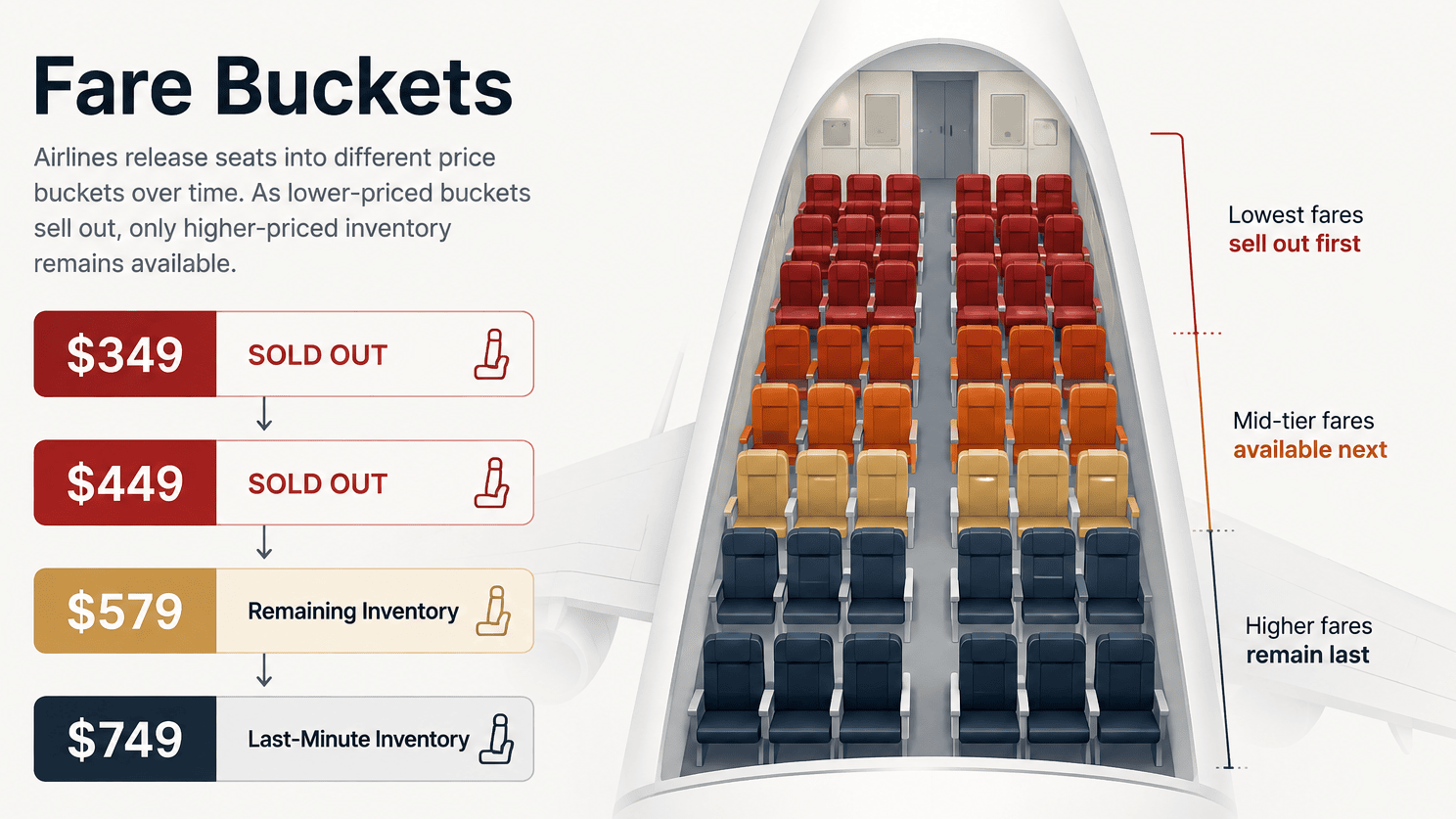
Although passengers often think an aircraft has “cheap seats” and “expensive seats,” airlines actually divide each cabin into numerous pricing levels. These pricing levels are commonly referred to as fare buckets or booking classes.
Imagine an airline releases inventory like this:
| Fare Bucket | Seats Available | Price |
|---|---|---|
| Bucket A | 20 | $349 |
| Bucket B | 30 | $449 |
| Bucket C | 45 | $579 |
| Bucket D | Remaining | $749+ |
Once the first bucket sells out, those lower fares disappear. The airline doesn’t physically move passengers to different seats. Instead, the remaining inventory simply becomes more expensive.
Nothing about the flight has changed.
- The aircraft is the same.
- The crew is the same.
- The departure time is the same.
- Your seat is the same.
Only one thing changed:
The cheaper inventory no longer exists.
This explains why airfare can increase dramatically overnight without any operational changes.
Why Airlines Don’t Continuously Raise Prices
At first glance, it might seem like airlines simply increase prices every time someone books a ticket. In reality, pricing is far more sophisticated.
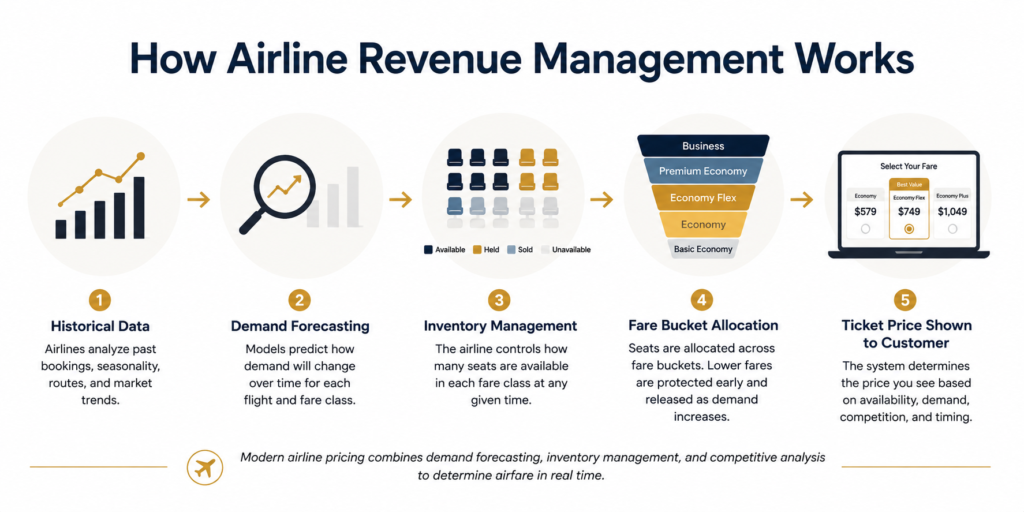
An airline doesn’t necessarily know exactly how many passengers will ultimately book a flight. Instead, it estimates demand using years of historical data combined with real-time booking activity.
If bookings are arriving faster than expected, lower fare buckets may close earlier. But if bookings are slower than expected, airlines may reopen cheaper inventory to stimulate demand.
This is why airfare sometimes appears unpredictable and hard to understand how airlines price flights. Because prices aren’t increasing because airlines are “randomly raising fares.”, they’re responding to constantly changing expectations about future demand.
Airline Pricing Is Really Demand Forecasting
Perhaps the biggest misconception about how airlines price flights is that airlines know exactly what a flight should cost. They don’t.
Every price you see is essentially a forecast. Airlines are constantly trying to answer questions like:
- How many people will eventually book this flight?
- How quickly will they book?
- What price are they willing to pay?
- What are competing airlines charging?
- Will demand increase or decrease over the coming weeks?
Every pricing decision reflects the airline’s best prediction of the future, not simply today’s demand. That means airfare behaves less like a fixed price and more like a financial market.
Prices adjust continuously as new information becomes available.
- A conference announcement.
- A competitor’s sale.
- A holiday weekend.
- A sporting event.
- Weather disruptions.
Even changes in consumer booking behavior can alter the airline’s pricing strategy. Understanding this helps explain how airlines price flights.
It’s not random.
It’s the result of thousands of constantly updated demand forecasts designed to maximize revenue, not simply fill seats.
Why Airlines Care More About Revenue Than Full Planes
One of the biggest misconceptions in air travel is that airlines simply want to fill every seat on every flight. It’s an understandable assumption. An empty seat looks like lost money.
But airlines aren’t measured by how full their airplanes are. They’re measured by how much revenue those airplanes generate.
This distinction changes everything.
Imagine two identical flights operating from New York to Los Angeles.
Flight A
- 100% full
- Average fare: $210
- Total revenue: $42,000
Flight B
- 91% full
- Average fare: $315
- Total revenue: $57,330
Although Flight B departed with several empty seats, it generated more than 36% additional revenue. From the airline’s perspective, Flight B was the more successful flight.
This illustrates one of the most important concepts in airline economics:
A full airplane is not necessarily a profitable airplane.
Instead of maximizing occupancy, airlines seek to maximize Revenue per Available Seat (RASM), a key financial metric that measures how effectively an airline converts its seat inventory into revenue.
The Goal of Revenue Management
Modern airline pricing is driven by Revenue Management, a discipline that combines economics, statistics, forecasting, and technology to determine the optimal price for every seat on every flight.
Every day, sophisticated algorithms analyze enormous amounts of data, including:
- Historical booking patterns
- Remaining seat inventory
- Current booking pace
- Seasonal demand
- Holidays and school schedules
- Competitor pricing
- Aircraft capacity
- Local events and conferences
- Weather disruptions
- Customer booking behavior
The objective isn’t simply to predict demand. It’s to answer one fundamental question:
What is the highest price someone is likely willing to pay for this seat before departure?
Every pricing decision attempts to maximize that opportunity.
Why Airlines Don’t Discount Empty Flights
One of the most common questions travelers ask is:
“If half the plane is empty, why don’t airlines just lower the price?”
The answer lies in probability. This is also why airlines can fly with empty seats without necessarily pricing the flight incorrectly. Imagine a flight departing in three weeks with fifty unsold seat and the airline has two options…
Option One
Reduce fares immediately. This means the remaining seats sell quickly at lower prices and the airplane departs full.
Option Two
Keep fares high. In return, some leisure travelers choose not to book. However, business travelers booking during the final week purchase those same seats at significantly higher prices.
If enough higher-paying passengers book, the airline earns substantially more revenue, even if a handful of seats remain empty.
Because airlines know that some passengers are far less sensitive to price, they often prefer waiting rather than discounting inventory too early.
This is why empty seats do not automatically translate into cheaper fares.
Why Last-Minute Flights Are So Expensive
Many travelers believe airlines charge more at the last minute simply because they know people are desperate. The reality is actually a bit more strategic.
Historically, travelers booking close to departure tend to fall into one of several categories:
- Business travelers
- Emergency travelers
- Travelers attending weddings or funerals
- Travelers with fixed schedules
- Travelers whose employer is paying
These customers generally have one thing in common:
They need to travel regardless of price.
Economists describe this as inelastic demand. When demand is relatively insensitive to price, airlines have little incentive to offer discounts.
Instead, they intentionally reserve higher-priced fare buckets for travelers booking close to departure. Contrary to popular belief, airlines aren’t attempting to punish procrastinators.
They’re matching prices to the willingness of different customer groups to pay.
Why Flights Sometimes Become Cheaper
Of course, airfare doesn’t always increase. Many travelers have experienced a flight that rose in price, only to become cheaper weeks later.
Why?
Because airline forecasting is never perfect. Forecasts are simply educated predictions and sometimes reality changes.
Examples include:
- Bookings developing slower than expected
- A competing airline launching a sale
- Additional capacity entering the market
- Weak economic conditions reducing demand
- Schedule changes making a flight less attractive
When these situations occur, airlines may reopen lower fare buckets to encourage additional bookings. Rather than representing randomness, these fare decreases reflect updated expectations about future demand.
Airfare pricing is dynamic because airline expectations are dynamic.
Competition Often Matters More Than Distance
Perhaps the biggest surprise for travelers is that distance has relatively little influence on ticket prices. Instead, airlines pay close attention to market competition. The same economics help explain why nonstop flights can cost more than connecting flights, even when the connecting itinerary requires more flying.
Consider these examples.
A nonstop flight from New York to London may cost less than a domestic flight from New York to Denver. At first glance, that seems impossible.
The international flight is:
- Much longer
- Requires more fuel
- Has larger crews
- Incurs higher airport fees
So why can it cost less? Because dozens of airlines compete aggressively across the North Atlantic and competition keeps fares under pressure.
Now consider a domestic route served by only one or two airlines.
With fewer competitors, airlines face less pricing pressure and often maintain higher average fares.
In other words:
Airlines don’t simply price the flight. They price the market.
That’s why understanding competition is just as important as understanding distance.
Real-World Examples of Airline Pricing
Once you understand revenue management, you’ll start to better understand how airlines price flights. For example:
A Tuesday afternoon flight in February may cost hundreds less than the same flight departing Friday evening before a holiday weekend.
Not because the flight is cheaper to operate, but because expected demand is dramatically different.
Likewise:
A leisure destination like Orlando during spring break behaves very differently from the same route during September.
Similarly, flights into cities hosting major conventions or sporting events often experience temporary fare increases as airlines anticipate stronger demand.
The underlying aircraft hasn’t changed…the market has. Every airfare reflects the airline’s current expectations about future demand—not simply the cost of operating the flight.
Key Takeaways
Before looking at how travelers can use this knowledge to make better booking decisions, remember these principles:
- Airlines maximize revenue, not occupancy.
- Empty seats are not automatically discounted.
- Revenue management relies on forecasting—not certainty.
- Last-minute fares target travelers with lower price sensitivity.
- Competition often influences airfare more than distance.
- Flight prices change because expectations change.
Once you understand these concepts, airfare becomes much easier to interpret.
Rather than asking:
“Why did this price change?”
You’ll begin asking:
“What changed in the airline’s expectations?”
That shift in perspective is the foundation of understanding how airlines really price flights.