
How Much Are Airline Miles Worth? How to Calculate the Value of Your Points
How Much Is an Airline Mile Worth?
One of the first questions people ask after accumulating airline miles is deceptively simple:
How much are my miles actually worth?
Unfortunately, there isn’t a single answer, because unlike cash, most airline miles don’t have a fixed value when redeemed for flights. The same 50,000 miles might replace a $400 ticket on one trip and a $2,000 ticket on another.
That’s because airlines can price award tickets differently based on the route, date, cabin, demand and loyalty program.
This creates both the opportunity, and confusion, of award travel.
A traveler who understands how to calculate airline miles value can compare different redemption options rather than blindly assuming that using points means getting a good deal.
The easiest place to start is with cents per point.
What Is Cents Per Point?
Cents per point, commonly abbreviated CPP, expresses the value you’re receiving from each point or mile you redeem. It is one of the most standardized ways for someone to calculate points value. Despite the name, the same concept applies to airline miles.
The basic calculation is:
Cash price of the flight ÷ number of miles required × 100
Suppose a flight costs either $600 cash or 40,000 miles. The calculation would be:
$600 ÷ 40,000 × 100 = 1.5 CPP
You’re receiving approximately 1.5 cents of value per mile.

That number gives you a standardized way to compare completely different redemption opportunities. However, one thing to note is that there’s an important adjustment we still need to make.
How to Calculate the Value of Airline Miles Correctly
Award tickets often require both miles and cash.
For example:
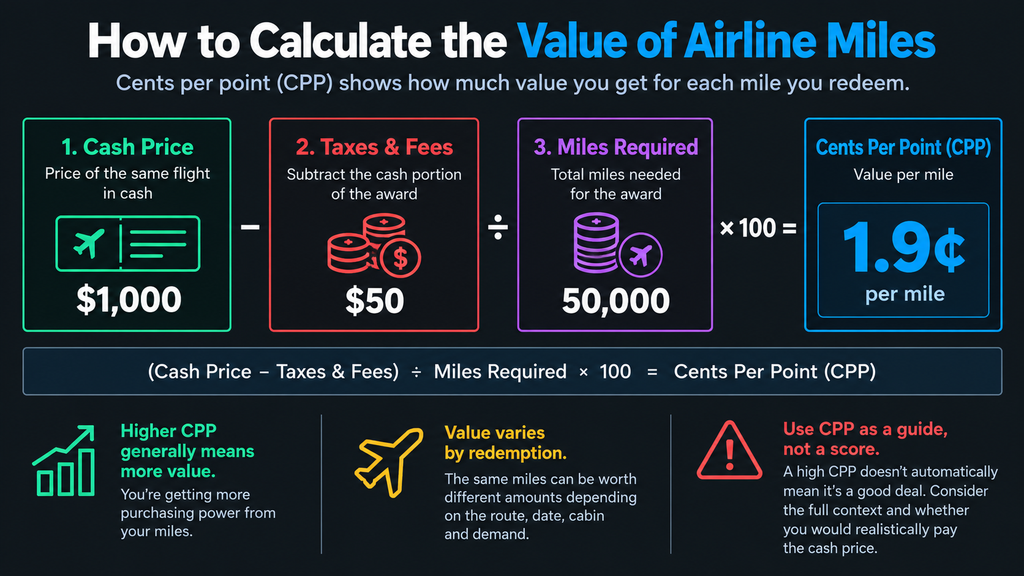
- Cash ticket: $1,000
- Award ticket: 50,000 miles + $50
You didn’t actually avoid spending the entire $1,000 because you still had to pay $50. So subtract the cash portion of the award from the cash price:
($1,000 – $50) ÷ 50,000 × 100
That gives you 1.9 cents per mile. This is a better representation of the value generated by your miles.
The general formula becomes:
(Cash Price − Award Taxes & Fees) ÷ Miles Redeemed × 100
There are some additional complexities, such as miles you would have earned on a paid ticket, but this calculation is sufficient for quickly comparing most award redemptions.
What Is a Good Cents-Per-Point Value?
You’ll frequently see websites publish valuations assigning particular values to different airline miles and transferable currencies.
These estimates can be useful as benchmarks, but they aren’t guarantees of what your points are worth.
Imagine two travelers each have 100,000 airline miles.
- Traveler A primarily flies inexpensive domestic routes and consistently gets around 1.2 cents per mile.
- Traveler B uses the same program for expensive international premium-cabin awards and sometimes receives more than 3 cents per mile.
They hold the exact same currency, yet their ability to extract value from it is completely different.That’s why published valuations are better treated as reference points rather than exchange rates.
Why Airline Miles Don’t Have a Fixed Value
Airline miles are fundamentally different from cash.
One dollar is worth one dollar regardless of when you spend it.
Miles are controlled by loyalty programs, and those programs determine how many miles are required for a particular award.
Historically, many airline programs relied heavily on award charts, where specific routes or regions required predetermined numbers of miles.
Today, many airlines use some form of dynamic award pricing, which can create enormous variation.
A domestic flight could theoretically cost:
- 8,000 miles on Tuesday
- 18,000 miles on Friday
- 35,000 miles during a holiday weekend
The underlying currency hasn’t changed, however the redemption opportunity has.
This is why asking “How much is one airline mile worth?” without considering how it will be redeemed only tells part of the story.
Cash Price Matters…But It Can Also Mislead You
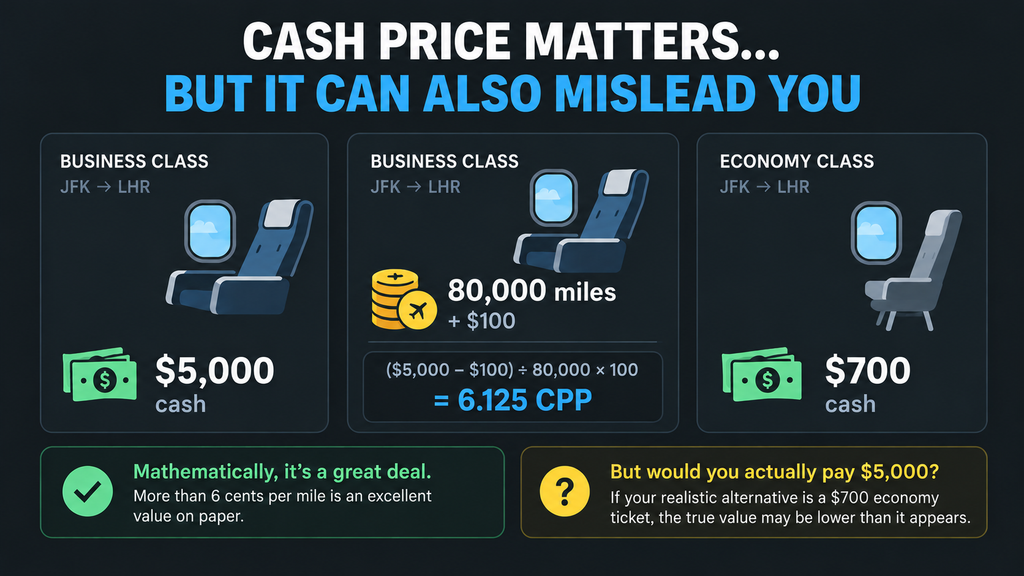
Suppose you find a business-class flight costing $5,000 cash or 80,000 miles + $100. If we think about how to calculate the points value, we’ll use the formula discussed above which would be:
($5,000 − $100) ÷ 80,000 × 100 = 6.125 CPP
More than six cents per mile looks phenomenal, and honestly speaking, ,athematically, it is. But there’s another question you should ask:
Would you actually pay $5,000 for that flight?
Suppose your realistic alternative was a $700 economy ticket. Redeeming 80,000 miles may still be an excellent decision. You’re getting a substantially better experience while avoiding thousands of dollars in cash expenditure.
But saying you “saved $5,000” can overstate the practical value you received if paying $5,000 was never a realistic option.
This is one of the biggest weaknesses of CPP.
Retail value and personal value aren’t necessarily the same thing.
Award Availability Matters Too
There’s another major limitation to airline mile valuations:
You can’t redeem miles for an award that isn’t available.
Suppose you’ve determined that 70,000 miles for a particular business-class flight would produce an incredible redemption. There’s only one problem…there are no award seats available on the day you need to travel.
Your theoretical valuation is irrelevant.
Award availability can therefore influence the practical value of your miles almost as much as the redemption price itself. Flexible travelers who can shift dates, airports or routes often have a greater ability to extract high CPP values.
Travelers constrained by work schedules, school calendars or specific events may have fewer opportunities. This is why the value of airline miles is partially dependent on how you travel, not simply which loyalty program you use.

For example, programs such as Singapore KrisFlyer and Cathay Pacific Asia Miles publish award charts that can produce dramatically different redemption values depending on the route and cabin you book. Other programs, such as Delta SkyMiles, use more dynamic award pricing, where the number of miles required can vary considerably from one flight or date to another.
A traveler who consistently redeems miles for expensive international premium-cabin flights may therefore get far more practical value from their miles than someone primarily redeeming for inexpensive domestic flights.
Should You Always Chase the Highest CPP?
No, and this is probably the most important takeaway from understanding airline mile valuations.
Consider two award options.
| Option A | Option B |
| Cash price: $900 | Cash price: $300 |
| Award price: 45,000 miles | Award price: 20,000 miles |
| Value: approximately 2 CPP | Value: approximately 1.5 CPP |
Option A produces the better mathematical return, but what if you actually need to take Flight B? Booking an unnecessary or inconvenient itinerary because it produces better CPP defeats the purpose of having the miles in the first place.
There are also circumstances where using miles at a relatively modest valuation makes perfect sense.
- Maybe cash fares are unusually expensive.
- Maybe you want to preserve cash.
- Maybe an award ticket offers better flexibility.
- Maybe the miles have been sitting unused for years.
Or maybe the redemption simply allows you to take a trip you otherwise wouldn’t take. CPP should inform that decision, it shouldn’t make it for you.
Airline Miles Can Lose Value Over Time
There’s another reason not to obsess over maximizing every mile:
Airline miles aren’t investments.
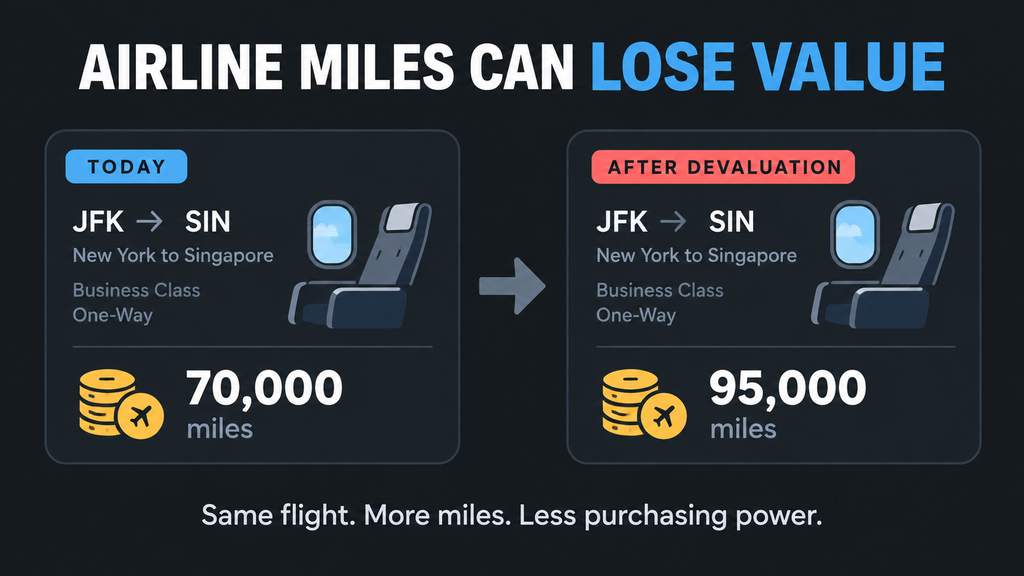
You don’t control the currency. Airlines and loyalty programs can change award pricing, alter redemption rules or increase the number of miles required for certain awards. That creates an important difference between points and traditional financial assets.
Flying Blue offers a recent example. Beginning September 8, 2026, the Air France-KLM loyalty program introduced new Light, Standard and Flex reward-ticket options, changing how members can redeem miles for award travel. Changes like these illustrate an important reality of airline miles: the rules governing their value can change even after you’ve earned them.
Holding miles indefinitely doesn’t necessarily increase their purchasing power.
In fact, the opposite can happen.
That’s not an argument for recklessly spending points. It’s simply an argument against waiting forever for the mythical “perfect redemption.”
If you have a valuable use for your miles today, extracting slightly less theoretical CPP can sometimes be preferable to holding them indefinitely hoping for something better.
When Should You Use Miles Instead of Cash?
CPP becomes most useful when you’re deciding between two ways of purchasing the same trip.
Suppose a flight costs $350 or 30,000 miles + $5.60. That’s approximately 1.15 cents per mile. If you value those miles considerably higher and can comfortably afford the $350 fare, paying cash may make sense.
Now imagine that same flight during a holiday weekend costs $850, while the award remains 30,000 miles + $5.60. You’re now receiving roughly 2.8 cents per mile.
Suddenly the award becomes much more compelling. This is one reason miles can be particularly useful when cash prices spike. The comparison isn’t simply points versus dollars.
It’s about what you’re giving up by choosing either option.
How to Evaluate Your Next Airline Miles Redemption
Before redeeming miles, run through a quick five-question test.
- What does the flight cost in cash? Use the ticket you would realistically purchase.
- What does the award cost? Include both the mileage requirement and cash fees.
- What CPP does the redemption produce? Use the adjusted calculation: (Cash Price − Award Fees) ÷ Miles × 100
- What are your alternatives? Check other flights, dates, airports and loyalty programs when practical.
- Would you be happy using your miles this way?
This last question sounds subjective because it is…points exist to eventually be spent.
So, How Much Are Your Airline Miles Really Worth?
The mathematical answer is relatively straightforward. Calculate how much cash you’re avoiding, subtract the cash portion of the award and divide the remainder by the number of miles you’re spending.
That tells you the cents-per-point value of the redemption.
But the economic answer is more complicated. Your miles are worth what they allow you to accomplish.
A 5 CPP redemption you don’t need isn’t inherently better than a 1.5 CPP redemption that saves hundreds of dollars on a trip you genuinely want to take.
That’s why The Fare Theory treats CPP as a decision-making tool rather than a scoreboard.
Calculate it, compare it, and understand the opportunity cost. Then make the decision that creates the most value for your trip.
Points are renewable. Time is not.