Is Buying Airline Miles Worth It? Why It’s Almost Never Worth It
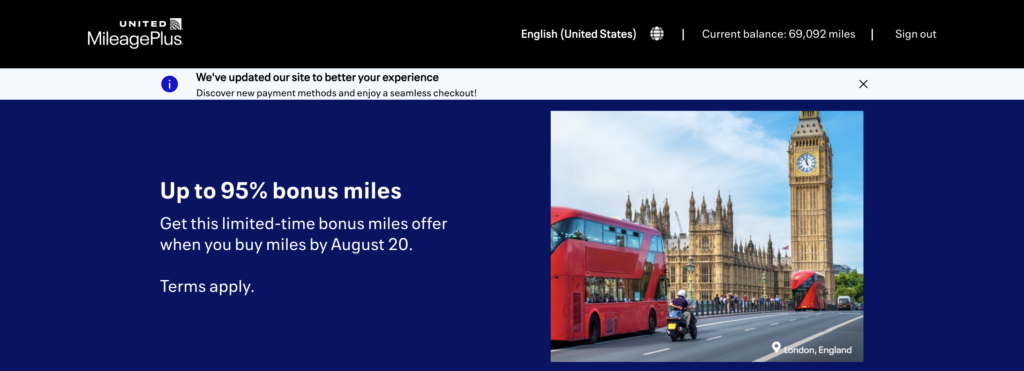
Every few weeks, airlines send promotional emails advertising offers like:
- “Up to 95% bonus miles”
- “Limited-time promotion!”
- “Lowest price of the year!”
At first glance, buying airline miles seems like an easy way to save money on future travel. If airline miles can be redeemed for expensive business-class flights, purchasing them at a discount sounds like a smart investment.
But here’s the reality:
Buying airline miles is almost never worth it.
Unless you already have a specific redemption ready to book, purchasing miles usually means paying cash today for a loyalty currency that can lose value tomorrow.
So before purchasing miles, it helps to first understand when using airline miles actually makes sense. Here’s when buying airline miles makes sense, and why, in most cases, you should avoid it.
Why Do Airlines Sell Airline Miles?
Before deciding whether if buying airline miles is worthwhile, you should be asking a different question:
Why are airlines so eager to sell them in the first place?
Most travelers assume airlines make the majority of their profits from selling tickets. In reality, airline loyalty programs have become incredibly valuable businesses of their own.
When an airline sells miles directly to customers, it receives cash immediately while delaying the cost of providing a future flight. Even better, the airline controls how and when those miles can be redeemed.
From the airline’s perspective, selling miles is often one of the highest-margin products it offers.
That doesn’t automatically mean buying them is a bad decision. But it should make you wonder who benefits most from the promotion.
Airline Miles Are Not an Investment
One of the biggest misconceptions in award travel is treating airline miles like an investment.
They’re not. Unlike cash, stocks, or even gift cards, airline miles are simply a loyalty currency controlled entirely by the airline.
You don’t own their value…the airline does. And the airline can change that value whenever it wants. That’s a major difference from traditional assets.
If your savings account contains $1,000 today, it’ll still contain $1,000 tomorrow. But 100,000 airline miles may buy a completely different flight next year than they do today.
Airline Miles Can Be Devalued at Any Time
One of the biggest risks of buying airline miles is something known as a devaluation.
Airlines routinely increase the number of miles required for award flights. Sometimes they announce the change in advance. Other times, award prices simply increase overnight.
A flight that costs 60,000 miles today might require 80,000 miles a few months from now.
- Nothing about the airplane changed.
- Nothing about your miles changed.
Only the airline’s pricing did.
Imagine spending $1,000 buying miles today, only to discover your planned redemption now costs 25% more miles before you’re ready to book.
That’s a risk many travelers never consider.
Buying Airline Miles Gives Airlines an Interest-Free Loan
When you purchase airline miles without a specific redemption in mind, you’re essentially giving the airline money today in exchange for a promise of future travel.
The airline receives:
- Immediate cash
- No obligation to provide a specific flight
- Complete control over future award pricing
Meanwhile, you receive:
- A currency that can lose value
- Limited redemption opportunities
- No guarantee your preferred flights will be available
That’s not a particularly balanced trade, because the longer you hold those miles, the more risk you’re taking.
Buying Airline Miles Usually Doesn’t Save Money
One of the biggest mistakes travelers make is assuming that paying with miles automatically means they’re getting a good deal.
In reality, the value of an award redemption depends entirely on how much the flight would have cost in cash compared to the number of miles required.
Take the Delta example below.
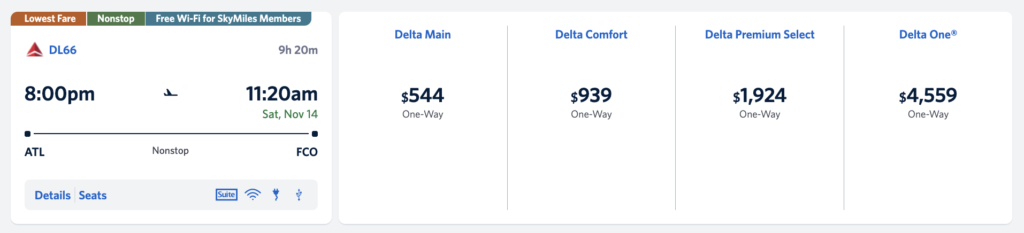
The exact same nonstop flight from Atlanta (ATL) to Rome (FCO) is available for:
- $544 in cash
- 41,300 SkyMiles + $6 one-way
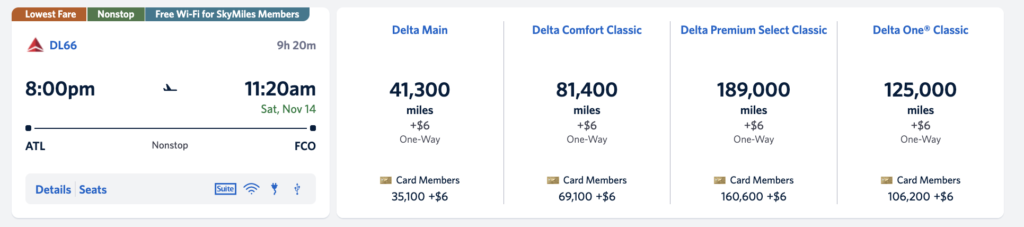
At first glance, using miles feels like a bargain. But when you divide the cash price by the number of miles required, you’re receiving only about 1.3 cents per SkyMile.
Now compare that to purchasing those same miles directly from Delta. In the example below, 50,000 SkyMiles cost $1,750, or roughly 3.5 cents per mile before taxes.
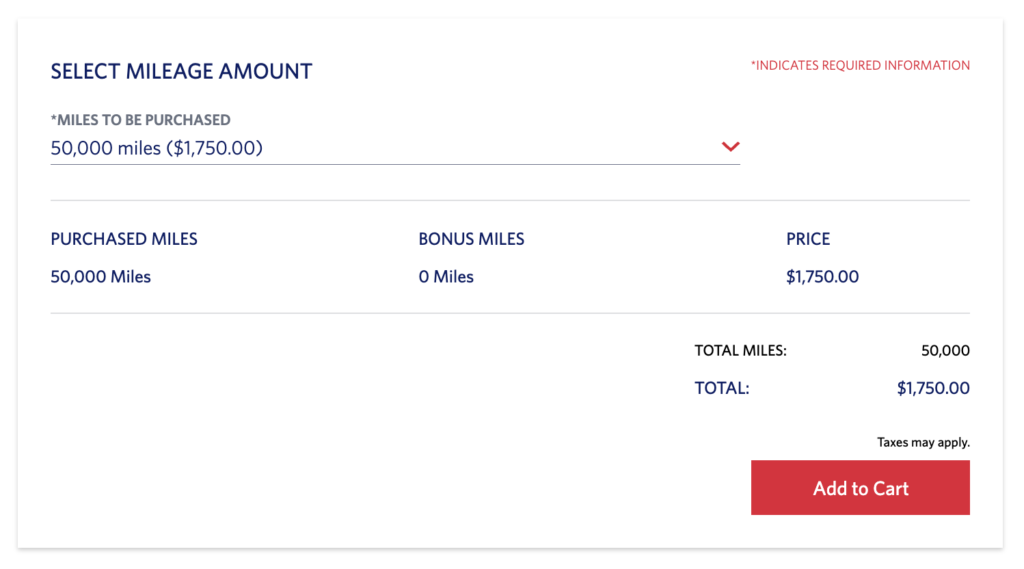
If you bought those miles specifically to book this flight, you’d spend approximately $1,440 worth of miles (41,300 × 3.5¢) for a ticket selling for just $544.
That’s nearly three times the cash price.
The airline isn’t offering you a bargain. It’s selling you a loyalty currency that’s often far more expensive than the value you’ll receive when you redeem it. This is why buying airline miles rarely makes financial sense unless you already have a specific high-value redemption in mind.
The excitement of “booking with miles” can easily distract travelers from asking a much simpler question:
Would I have been better off simply paying cash?
When Buying Airline Miles Actually Makes Sense
There are situations where buying airline miles can be an excellent financial decision.
The key difference is that you’re purchasing miles for an immediate redemption, not for some hypothetical future trip.
Imagine:
- A business-class ticket costs $4,000
- The same flight costs 75,000 miles
- You already have 55,000 miles
- Purchasing the remaining 20,000 miles costs $500
Instead of paying $4,000, you spend $500 to complete the redemption.
That’s a very different situation than buying 75,000 miles months before you’ve decided where you’re traveling.
You’re using the miles immediately, which greatly reduces the risk of devaluation or changing award availability.
My Rule for Buying Airline Miles
I generally only consider purchasing airline miles when all three of these conditions are true.
1. I Already Have a Specific Redemption Ready
The biggest mistake travelers make is buying miles because they think they’ll eventually use them.
Travel plans change. Award availability disappears. Airlines adjust pricing. A dream trip you expect to book next summer may never materialize, leaving you with thousands of miles sitting in your account while they gradually lose purchasing power.
Instead, I only buy miles when I’ve already searched for the award flight, confirmed that seats are available, and I’m ready to complete the booking immediately.
In other words, the miles solve a problem I have today, not one I might have six months from now. If I’m buying miles because they’re “on sale,” I probably shouldn’t be buying them at all.
2. The Math Clearly Works
Before purchasing miles, I compare the total out-of-pocket cost against simply paying cash. That means looking beyond the promotional headline.
If I need to spend $1,100 buying miles for a business-class redemption that would cost $1,300 in cash, I’m taking on significant risk to save only $200. Personally, that isn’t enough to justify purchasing a currency that can be devalued or an award ticket that could disappear before I book.
On the other hand, if buying miles allows me to book a $4,000 flight for roughly $1,200, the economics become much more compelling.
The goal isn’t to use miles simply because they’re available. The goal is to create meaningful savings after accounting for every dollar spent.
If the difference is small, I’d rather keep the flexibility that comes with paying cash.
3. I Intend to Redeem the Miles Immediately
Time is the biggest enemy of airline miles.
The longer you hold them, the greater the chance that something changes. Award prices can increase, airlines can alter routing rules, promotions can end, or the seats you planned to book can disappear altogether.
That’s why I treat purchased miles almost like a bridge rather than an investment. Ideally, I purchase the miles and redeem them within minutes or hours, not months.
Buying miles without an immediate redemption is essentially betting that nothing will change before you use them. History has shown that’s rarely a good bet.
The shorter the holding period, the less exposure you have to devaluations and the greater the likelihood that the value you calculated is the value you’ll actually receive.
Frequently Asked Questions
Is buying airline miles worth it?
Usually not.
Buying airline miles is generally only worthwhile when you already have a specific award ticket available and purchasing the required miles costs significantly less than paying cash.
When should you buy airline miles?
The best time to buy airline miles is immediately before redeeming them. Holding miles for months or years increases the risk that the airline raises award prices before you use them.
Why do airlines sell airline miles?
Selling airline miles generates immediate cash while allowing airlines to maintain complete control over future redemption pricing and availability. It’s one of the reasons airline loyalty programs are such profitable businesses.
Do airline miles expire?
Some airline loyalty programs expire miles after a period of account inactivity, while others keep miles active indefinitely.
Always review the rules of your specific frequent flyer program.
The Fare Theory
Airlines don’t promote buying miles because they’re trying to help travelers save money.
They promote them because selling miles generates immediate revenue while allowing them to control the value of the currency they’ve created.
That doesn’t mean buying airline miles is always a mistake. It means you should treat miles as a tool, not an investment.
Buy them only when you already know exactly how you’ll use them, the redemption is available, and the math clearly works in your favor.
Otherwise, you’re accepting all of the risk while the airline keeps all of the flexibility.
The best airline miles aren’t the ones sitting in your account. They’re the ones you’ve already redeemed for experiences you’ll actually remember.