

Points vs. Cash: Why Spending Miles Feels Easier
Travel rewards enthusiasts spend countless hours earning points, maximizing transfer bonuses, and searching for award availability. Yet one of the strangest behaviors in award travel happens after we’ve accumulated those points: spending points often feels much easier than spending cash.
Imagine a business class ticket to Europe costs $5,000. Most travelers would never consider paying $5,000 for the flight. But offer that exact same seat for 300,000 airline miles and suddenly it can feel like a great deal.
Same traveler. Same seat. Same flight.
But a completely different emotional response.
Why?
Because airline miles don’t feel like money.
That psychological difference can influence how we value award flights, calculate the value of airline miles, and ultimately decide whether they should use points vs cash.
Airline Miles Live in a Different Mental Account
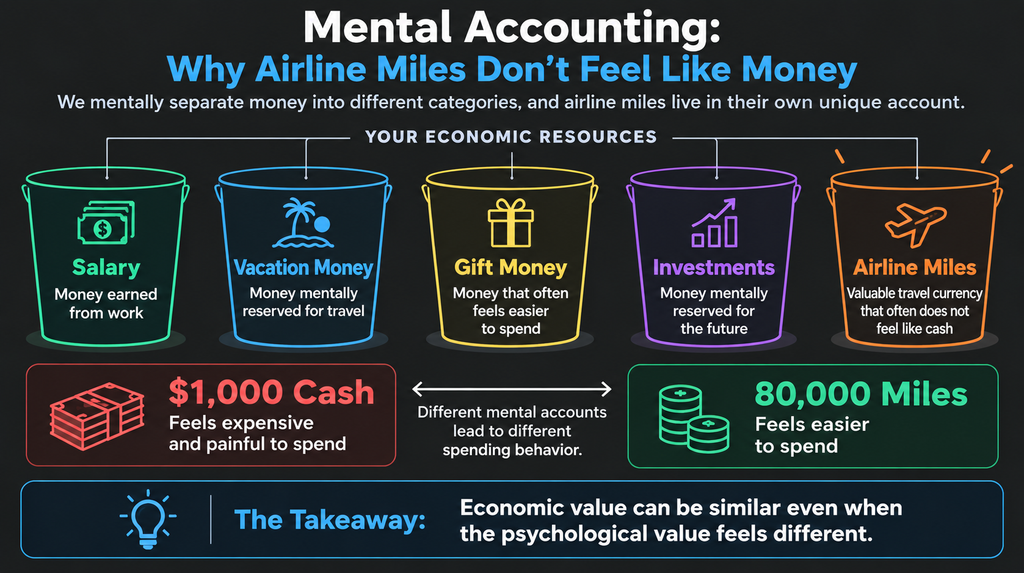
Behavioral economists call this phenomenon mental accounting.
The concept, associated with economist Richard Thaler, describes our tendency to mentally separate money into different categories depending on where it came from or what we intend to use it for.
You might subconsciously separate your money into categories such as:
- Salary
- Vacation money
- Gift money
- Investments
Even though a dollar is economically worth a dollar regardless of which category it occupies, we don’t necessarily treat every dollar the same way.
Airline miles create an even more unusual mental account.
Points earned from flights, loyalty programs, or everyday spending don’t necessarily create the same psychological association as money deposited into a checking account.
As a result, spending 80,000 miles can feel less painful than spending $1,000, even when those miles have substantial economic value.
That’s one reason travelers should understand how much their airline miles are actually worth before deciding how to use them.
Why Points Can Feel Like Monopoly Money
Imagine finding a casino chip worth $100 in your pocket. Even though you know it’s worth $100, you might be more willing to gamble it than you would a $100 bill from your wallet.
Airline miles can create a similar psychological effect.
Loyalty currencies are abstract:
- 80,000 miles doesn’t necessarily feel like $1,000.
- 300,000 miles doesn’t necessarily feel like several thousand dollars.
- A balance of 1 million miles can look more like a score than a financial asset.
And unlike dollars, every loyalty program creates its own rules for earning and spending that currency.
- You accumulate miles.
- You unlock awards.
- You search for availability.
- You transfer points between programs.
- You try to maximize redemptions.
All of this can make award travel feel more like a game than a financial transaction, but the miles still have value.
That’s why deciding when to use airline miles instead of paying cash should involve more than simply asking whether you have enough points in your account.
The Cents-Per-Point Trap
One of the most common ways travelers evaluate award flights is cents per point, often abbreviated CPP. The basic calculation is straightforward:
Cash price of the flight ÷ number of points required = cents per point
A redemption generating:
- 1.2 cents per point might feel disappointing.
- 3 cents per point might feel excellent.
- 8 cents per point might look extraordinary.
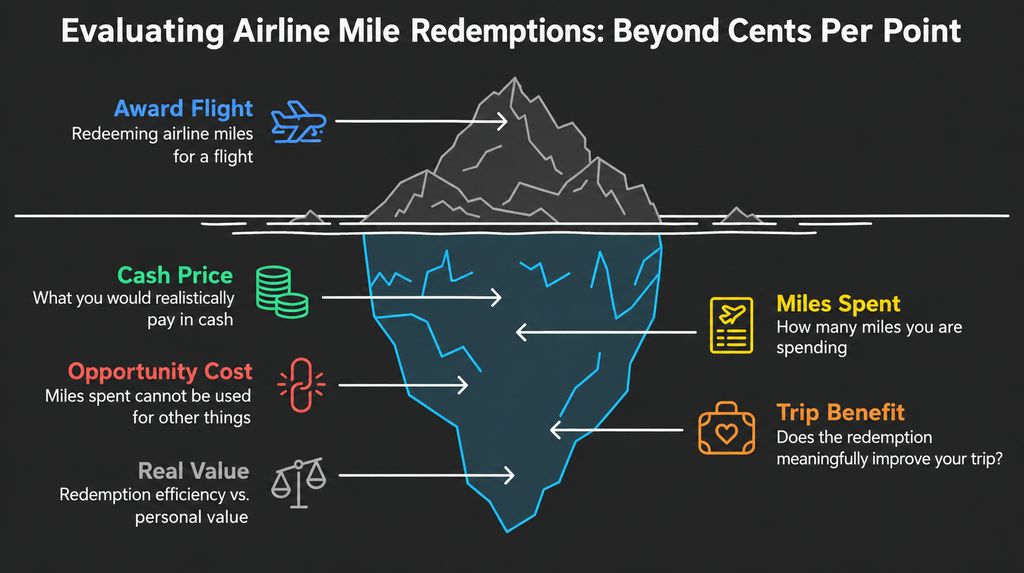
CPP is useful because it gives travelers a standardized way to compare the value they’re receiving from their miles. But cents per point measures redemption efficiency. It doesn’t necessarily measure personal value.
Consider that $5,000 business class ticket again. If an award requires 100,000 miles, you might calculate a redemption value approaching 5 cents per point.
On paper, that’s fantastic.
But suppose you would never pay $5,000 for that ticket. Maybe you would have purchased a $700 economy ticket instead.
Did redeeming those miles really “save” you $5,000? Not exactly.
The redemption allowed you to experience a product you otherwise wouldn’t have purchased. That can still be an excellent use of miles, but it’s different from actually saving $5,000.
That’s an important distinction when calculating cents per point and determining what your miles are worth.

A High CPP Doesn’t Automatically Make a Good Redemption
This is where award travel gets more complicated, and some travel folks might begin to disagree. Travelers can become so focused on maximizing CPP that the number itself becomes the goal.
But imagine two options:
| Option A | Option B |
| Economy ticket: $600 | Business class ticket: $4,500 |
| Award price: 45,000 miles | Award price: 100,000 miles |
Option B produces a dramatically higher theoretical CPP, however, that doesn’t automatically mean it’s the better decision. Those additional 55,000 miles have an opportunity cost. They could potentially fund another flight, an upgrade, or part of a future trip.
The better question isn’t:
Which redemption produces the highest CPP?
It’s:
What am I actually receiving in exchange for these miles?
That’s the distinction between simply maximizing a calculation and understanding what makes an award redemption actually good.

Why Airlines Benefit When Miles Don’t Feel Like Money
Airline loyalty programs benefit from points being psychologically separated from cash. Unlike dollars, airline miles exist within an ecosystem controlled by the loyalty program.
Depending on the program, airlines can change award pricing, alter redemption rules, introduce dynamic pricing, modify partner availability, or devalue their loyalty currency.
That creates another important difference between miles and cash:
You control your cash. The loyalty program controls the currency.
Holding miles indefinitely therefore carries its own risk. However, the psychological separation between miles and money can also influence the opposite behavior: travelers may spend miles simply because using points feels “free.”
Neither extreme is particularly useful.
- Hoarding miles forever exposes you to potential devaluation.
- Spending them without considering their value can waste a useful travel currency.
And purchasing additional miles simply to complete a redemption adds another layer to the calculation. Before doing so, it’s worth understanding when buying airline miles actually makes financial sense.
Points Aren’t Free, But That Doesn’t Mean You Shouldn’t Spend Them
None of this means travelers should avoid using their miles. It’s actually quite the opposite because miles are generally most useful when they help you accomplish something that matters to you.
- Maybe that’s flying business class on an overnight flight.
- Maybe it’s visiting family during an expensive holiday weekend.
- Maybe it’s avoiding a $900 last-minute airfare.
- Or maybe it’s simply taking a trip you otherwise couldn’t justify paying for in cash.
The point isn’t to maximize the theoretical dollar value of every mile, it’s to understand the trade you’re making.
That same framework becomes particularly useful when evaluating premium cabins. Instead of asking whether business class or premium economy is “worth it” in the abstract, consider the incremental value you’re receiving for the additional cash or miles required.
A Better Way to Decide Whether to Spend Your Miles
Before making an award booking, ask yourself four questions:
- What would I realistically pay for this flight in cash?
- How many miles am I spending?
- What else could I reasonably use those miles for?
- Does this redemption meaningfully improve my trip?
Those questions provide more context than CPP alone.
A technically mediocre redemption can still be a great decision if it saves meaningful cash or makes an important trip possible. Likewise, an 8-cent-per-point redemption isn’t automatically incredible simply because an airline happens to charge an enormous cash price for the same seat.
The goal isn’t to win the points game.
It’s to use your miles in a way that creates real value for your travel.
The Fare Theory
Airline miles aren’t free money, they’re a currency that feels different from money.
It’s important to know the difference because once points become disconnected from dollars in our minds, it’s easy to evaluate award travel differently from any other purchase.
So the next time you’re about to redeem miles, don’t only ask:
“How many cents per point am I getting?”
Ask:
“What am I actually getting in exchange for these miles?”
Sometimes spending the points will be the obvious choice, but sometimes paying cash will preserve your miles for something more valuable. And other times, the redemption with the highest theoretical value won’t be the best decision at all.
Points are renewable. Time is not.