
How to Redeem Airline Miles: A Beginner’s Guide
How to Redeem Airline Miles: A Beginner’s Guide
Airline miles can make flights significantly cheaper, unlock premium cabins and occasionally provide access to trips that would otherwise be prohibitively expensive.
But earning miles is only half the equation.
Eventually, you have to figure out how to actually use them.
For someone new to airline loyalty programs, redeeming miles can seem unnecessarily complicated. Airlines use terms like award travel, award availability, mileage redemption and taxes and carrier-imposed surcharges. You may search for a flight and see several different mileage prices for what appears to be the same trip.
Fortunately, the basic process is much simpler than the terminology makes it sound.
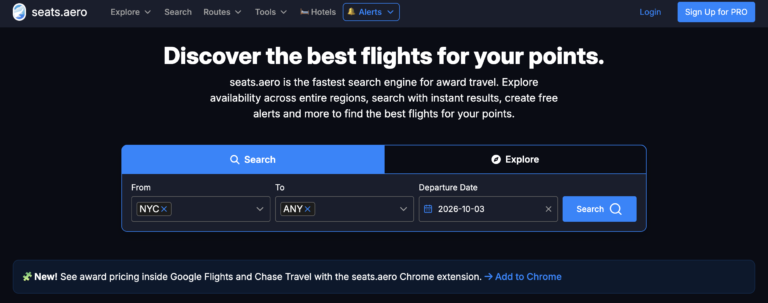
In most cases, redeeming airline miles follows the same general process:
Find your miles → search for award flights → select miles instead of cash → review the mileage price and fees → compare it against the cash fare → book.
The mechanics aren’t particularly difficult.
Figuring out whether the redemption is actually a good use of your miles is where things become more interesting.
What Are Airline Miles?
Airline miles are loyalty currencies issued by airline frequent-flyer programs.
Despite being called “miles,” their value generally isn’t tied directly to the physical distance you fly.
Instead, you earn a balance of miles that can later be redeemed for rewards, most notably airline tickets.
Depending on the program, miles may be earned through:
- flying
- airline partners
- shopping portals
- dining programs
- hotel and rental-car partners
- transferable rewards programs
- co-branded credit cards
Once those miles are deposited into your frequent-flyer account, they essentially become another currency you can potentially use to purchase travel.
But unlike dollars, airline miles don’t have one universally fixed value, which is an important thing to note when you’re deciding whether to redeem them.

How to Redeem Airline Miles
The exact interface differs between airlines, but most airline mileage redemptions follow a similar process.
Let’s walk through it from beginning to end.
Step 1: Find Your Airline Miles Balance
Before searching for a flight, figure out exactly what currency you have and how much of it you own. You can do this by logging into the airline’s website or app and navigate to your frequent-flyer account.
Your mileage balance will typically appear prominently within your account. For example, if your account shows 62,500 miles, that’s the amount currently available for an award redemption through that loyalty program.
This sounds obvious, but there’s an important distinction for beginners:
Miles aren’t automatically interchangeable between airlines.
Having 60,000 United MileagePlus miles doesn’t mean you can simply move those miles into a Delta SkyMiles account. Airline partnerships can sometimes allow you to book another airline using your existing miles, but that’s different from transferring the miles themselves (we’ll come back to this later…).
Step 2: Search for Your Flight
Once you know which miles you have, search for your desired trip through the airline’s website or app. You would essentially search with the same basic information you would for a normal flight search:
Origin → Destination → Dates → Number of passengers → Cabin
The important difference is that you need to tell the airline you want to search using miles.
Different airlines label this differently.
You might something such as:
- Book with miles
- Use miles
- Award travel
- Pay with points
Selecting this tells the booking system to return award prices rather than, or sometimes alongside cash fares.

Step 3: Look at the Award Price
Instead of seeing only something like $684 round trip, you may now see 35,000 miles + $6. That is an award ticket. The airline is asking you to exchange 35,000 miles from your account plus $11.20 in required cash for the ticket.
But this is where airline award travel starts becoming more complicated. Not every flight necessarily costs the same number of miles.
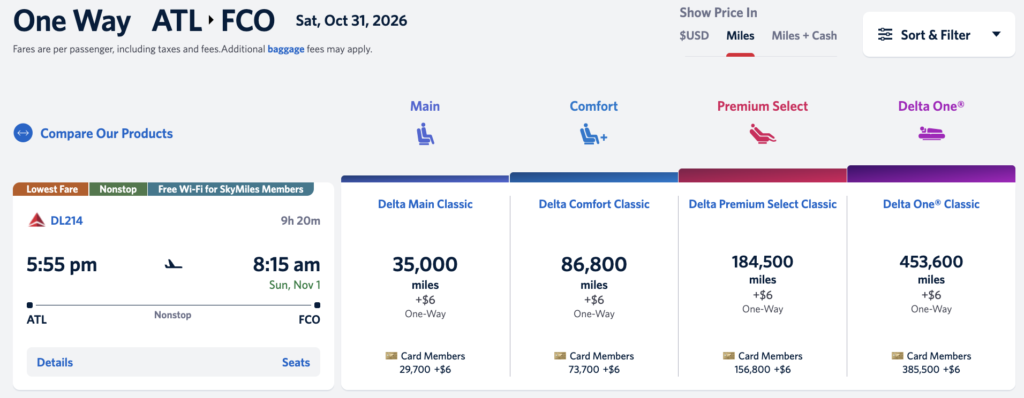
When you book flights with miles, there may be multiple trip options. While one option costs 35,000 miles, another could cost 47,500 miles, and maybe a third option costs 80,000 miles.
Award pricing can vary by airline, route, date, cabin, demand and availability. Some loyalty programs publish award charts or redemption tables, while others use more dynamic pricing models.
That’s why searching nearby dates can sometimes make an enormous difference.
If your travel dates are flexible, checking several departures around your preferred date can potentially uncover a much cheaper award.
Step 4: Understand Taxes and Fees
One of the biggest misconceptions about award travel is that a ticket purchased with miles is completely free…usually, it isn’t.
You may still need to pay government taxes, airport fees and, depending on the airline or award, potentially substantial carrier-imposed surcharges.
So when you redeem airline miles, an award might cost 60,000 miles + $5.60, while another could cost: 60,000 miles + $350 even though both technically require the same number of miles.
This becomes particularly important when comparing award tickets. A redemption requiring fewer miles isn’t necessarily better if it comes with dramatically higher cash charges.
Always look at both sides of the price:
Miles required + cash required
before booking.
Step 5: Compare the Award Against the Cash Price
This is the step beginners are most tempted to skip.
- You’ve found an available flight.
- You have enough miles.
- The airline lets you book it.
So you should redeem them, right?
Not necessarily.
Just because you can redeem miles doesn’t mean you should. Before booking, open the same itinerary as a normal cash search and see what the ticket actually costs.
Looking back at our previous example from ATL -> FCO, the cash price would be $724 or 35,000 miles + $6.
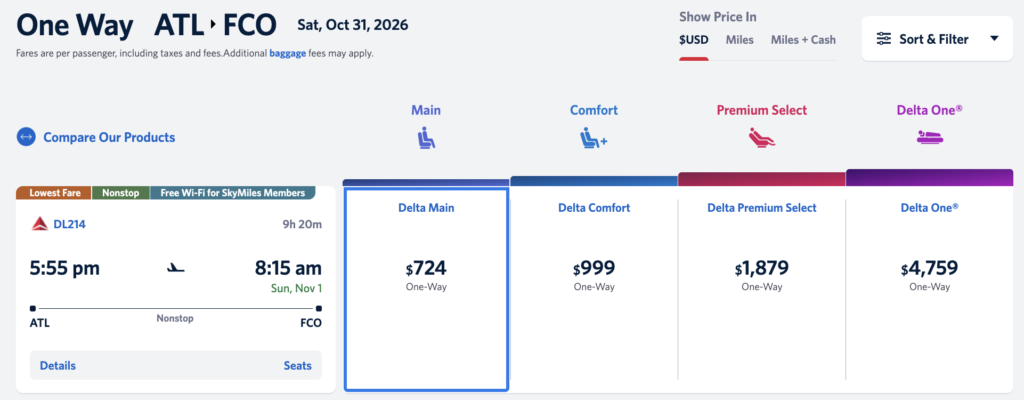
You can calculate the approximate value you’re receiving from the redemption using cents per point, commonly abbreviated CPP.
The basic calculation is (Cash Price − Award Taxes/Fees) ÷ Miles Required × 100
In this example ($724 − $6) ÷ 35,000 × 100 = 2.05 CPP. You’re receiving approximately 2.05 cents of value per mile.
That’s a relatively strong redemption on paper, but CPP alone doesn’t automatically mean you should use your miles. You should still consider whether you’d actually pay the $724 cash fare and whether saving your miles for another trip could provide greater value.
Step 6: Decide Whether to Use Miles or Pay Cash
Now you’ve reached the part that matters most at The Fare Theory.
The question isn’t simply:
Can I use miles?
It’s:
Does using miles make sense for this particular trip?
Imagine you have 80,000 miles.
You find two potential uses.
| Flight A | Flight B |
| Cash price: $240 | Cash price: $1,100 |
| Award Price: 24,000 miles + $6 | Award Price: 45,000 miles + $6 |
| CCP: ~0.98 CPP | CCP: ~2.43 CPP |
While yes, you have enough miles for either ticket, those redemptions aren’t remotely equivalent.
- Using 24,000 miles to avoid spending $234 produces roughly 0.98 CPP.
- Using 45,000 miles to avoid spending $1,094 produces roughly 2.43 CPP.
If both trips are otherwise comparable, preserving the miles for Flight B could produce substantially more value.
But even that isn’t the entire decision.
Cash flow, your mileage balance, future travel plans, cancellation flexibility and how much you personally value the trip can all matter. That’s why we’ve built a separate framework specifically around this decision: When to Use Airline Miles: Cash vs. Miles.
Step 7: Book the Award Ticket
If you’ve decided that using miles makes sense, the rest generally works much like buying a normal airline ticket. You’ll then select the desired flight and continue through checkout.
You’ll typically see a final breakdown showing:
- Mileage cost
- Taxes and fees
- Passenger information
- Flight details
- Cabin
Review everything carefully before confirming the redemption.
Once you complete the transaction, the airline deducts the required miles from your frequent-flyer account and charges the applicable taxes and fees to your payment method.
You should then receive a ticket confirmation just as you would with a cash booking.
What Happens After You Book a Flight With Miles?
An award ticket is still an airline ticket. You’ll receive a reservation or confirmation number and generally manage the trip through the airline’s website or app.
Depending on the ticket and airline, you may be able to:
- select seats
- add baggage
- enter traveler information
- modify the reservation
- cancel the ticket
- check in online
- add eligible frequent-flyer information
However, award-ticket change and cancellation rules vary between loyalty programs. Don’t assume that because you booked with miles the ticket is automatically fully refundable.
Make sure you review the specific program’s rules before making the redemption, particularly if your plans aren’t firm.

Can You Use Miles to Book Flights on Other Airlines?
Sometimes, and this is one of the most useful concepts in award travel. Airlines frequently belong to alliances or maintain individual partnerships with other carriers.
That can allow you to redeem one airline’s miles for a flight operated by another airline.
For example, you don’t necessarily need miles issued by the airline whose aircraft you’re actually flying. If partner award availability exists, you may be able to book that flight through another loyalty program.
This creates an important distinction:
The airline operating your flight and the loyalty program issuing your award ticket don’t always have to be the same company.
Take the below screenshot for example. When looking at flights from Atlanta to Paris, you could use your Delta miles to book an Air France operated flight. This is because Delta and Air France are a part of the SkyTeam alliance.
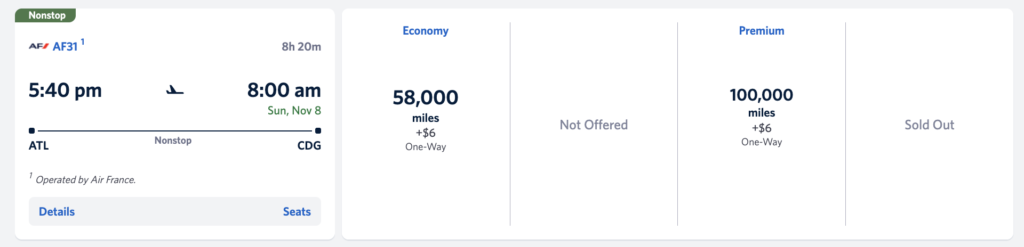
Partner awards are where award travel becomes substantially more powerful, and substantially more complicated. For your first redemption, don’t worry about mastering every partnership immediately.
They key is to learn how to search and book straightforward awards first, then start exploring partner opportunities.
Why Can’t I Find a Flight Using Miles?
Having enough miles doesn’t guarantee that every flight will be available at an attractive mileage price.
This is because airlines control award inventory just like they manage cash inventory. A flight may have seats available for purchase while offering poor award pricing, or no useful partner award availability.
Availability can also change over time. A flight unavailable today might become available later, while an award you see today could disappear tomorrow.
This is another consequence of airlines actively managing inventory based on expected demand.
Should You Save Airline Miles for Later?
The answer isn’t always as clear as yes or no. Realistically, the answer sometimes. But miles shouldn’t automatically be treated like a long-term investment account.
Airlines control their loyalty currencies and can change redemption prices or program rules. That means accumulating an enormous balance indefinitely isn’t necessarily the optimal strategy.
If you have a redemption that meaningfully improves a trip and produces reasonable value, using your miles can make sense even if it isn’t the theoretically perfect redemption.
The goal isn’t to die with the world’s greatest CPP spreadsheet.
It’s to use miles to make travel better.

Common Airline Mile Redemption Mistakes
For your first few redemptions, I’d pay particular attention to five mistakes:
- Redeeming without checking the cash price. A mileage price can look attractive until you discover the cash fare is unusually cheap.
- Ignoring taxes and surcharges. Compare the complete award cost rather than mileage requirements alone.
- Assuming every mile has the same value. Loyalty currencies differ, and even the same currency can produce dramatically different value depending on how it’s redeemed.
- Using miles simply because you have them. Availability doesn’t automatically equal value.
- Waiting forever for the perfect redemption. CPP is a useful measurement, not a competition.
The Fare Theory Take
Redeeming airline miles isn’t particularly complicated once you understand the basic mechanics.
The process is generally:
Find your balance → Search with miles → Find award availability → Check taxes and fees → Compare against cash → Decide → Book
The more difficult question is determining whether the redemption is actually worthwhile.
That’s where understanding mileage value becomes more useful than simply understanding how to click “Book with Miles.”
A great redemption doesn’t necessarily have to produce the highest mathematical value possible.
It should help you take a trip you want, reduce a meaningful cash expense or improve your travel experience at a cost you’re comfortable paying.
Miles are a tool. The goal isn’t to maximize the currency. It’s to maximize what the currency lets you do.
FAQ: How to Redeem Airline Miles
How do I redeem airline miles for a flight?
Log into your airline loyalty account, search for your desired itinerary, select the option to book using miles or award travel, choose an available award flight and pay the required miles plus applicable taxes and fees.
Do you still pay taxes when using airline miles?
Usually, yes. Award tickets can still include government taxes, airport charges and sometimes carrier-imposed surcharges.
Is it better to use miles or pay cash?
It depends on the cash fare, mileage requirement, taxes and fees, your available mileage balance and how much you value preserving those miles for future travel.
Can I use airline miles for someone else?
Many airline programs allow members to redeem miles for another traveler, although individual program rules vary.
Can airline miles pay for the entire ticket?
Miles can cover the underlying award fare, but most award tickets still require at least some cash payment for applicable taxes and fees.
Do flights booked with miles earn more miles?
Typically, traditional award tickets don’t earn redeemable miles in the same way as eligible paid tickets, although policies can vary by program and ticket type.