
Open-Jaw Flights Explained: What They Are and When They Save You Money
If you’ve ever wondered whether you can fly into one city and return home from another, the answer is yes. This type of itinerary is called an open-jaw flight.
Instead of booking a traditional round trip and eventually retracing your steps back to the airport where you arrived, an open-jaw itinerary allows you to continue traveling through a region and fly home from somewhere else.
For example, you could fly from New York to Paris, travel through France by train, and eventually fly home from Nice.
For multi-city trips, this can eliminate hours of unnecessary backtracking and sometimes reduce the total cost of the trip. And more importantly, it illustrates one of the central ideas behind The Fare Theory:
The cheapest flight isn’t necessarily the itinerary that provides the most value.
What Is an Open-Jaw Flight?
An open-jaw flight is an itinerary where one end of your return journey doesn’t match the corresponding airport on your outbound journey.
A simple example would be:
- Fly New York (JFK) → Paris (CDG)
- Travel independently through France
- Fly Nice (NCE) → New York (JFK)
There is no flight connecting Paris and Nice as part of the airline itinerary. You cover that portion of the trip yourself, whether that’s by train, rental car, another flight or some other form of transportation.
That missing segment creates the “open jaw.”

Open-Jaw vs. Round-Trip Flights
A traditional round-trip itinerary might look like:
- JFK → Paris → JFK
An open-jaw itinerary could instead look like:
- JFK → Paris
- Travel independently through Europe
- London → JFK
The major difference is that the airline isn’t responsible for transporting you between Paris and London.
You are.
That might initially sound less convenient, but for the right trip, it’s exactly what makes an open-jaw flight so useful. Instead of designing your vacation around getting back to your original arrival airport, you can design your flights around where your trip naturally begins and ends.
What Are the Different Types of Open-Jaw Flights?
There are actually several ways to construct an open-jaw itinerary.
Destination Open Jaw
This is probably the version most travelers think about. You leave from the same city but fly into and out of different destinations:
- New York → Paris
- Nice → New York
You travel from Paris to Nice independently.
Origin Open Jaw
An origin open jaw changes the airport on the home side of the itinerary.
- New York → Paris
- Paris → Washington, D.C.
Your outbound journey begins in New York, but your return journey ends in Washington.
Double Open Jaw
A double open jaw changes airports on both sides:
- New York → Paris
- Rome → Washington, D.C.
You independently travel from Paris to Rome, and the itinerary doesn’t return you to your original departure city. These structures can become useful when you’re planning longer trips or have flexibility around multiple airports.
Open-Jaw vs. Multi-City Flights
Open-jaw and multi-city are often used interchangeably, but they don’t mean exactly the same thing.
- An open jaw describes the structure of an itinerary.
- A multi-city search is a booking method that allows you to enter multiple flight segments.
For example, consider:
- New York → London
- London → Rome
- Rome → New York
- London → Rome
That’s a multi-city itinerary, but it isn’t necessarily an open jaw because you’re flying between each destination.
Compare that with:
- New York → London
- Travel independently from London to Rome
- Rome → New York
Now there’s a gap between London and Rome, creating the open jaw.
In practice, however, the distinction can get confusing because airline websites and flight-search tools commonly have you select “Multi-city“ when searching for an open-jaw itinerary.

How to Book an Open-Jaw Flight
Booking an open-jaw flight is usually fairly straightforward. Rather than selecting Round Trip when searching for flights, look for an option such as Multi-city or Multiple destinations.
Then enter each flown portion separately.
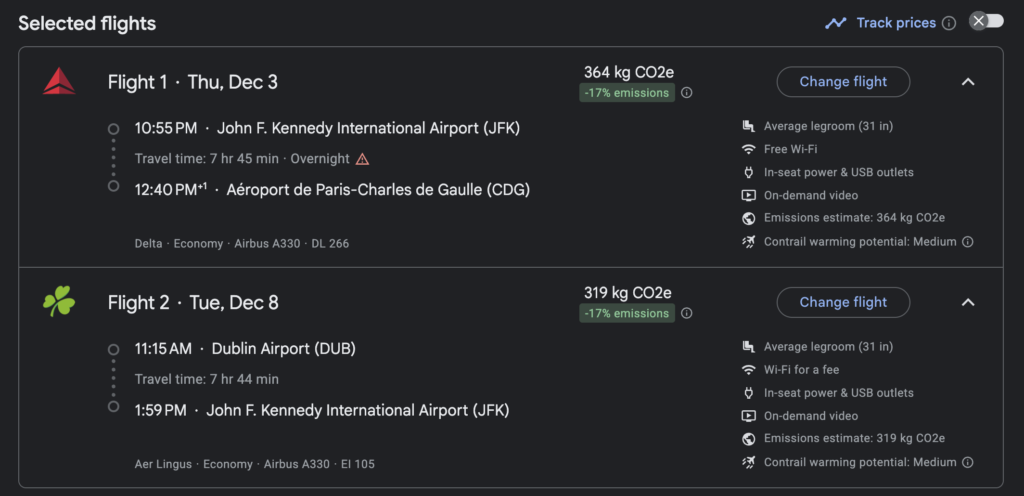
For example:
Flight 1: New York → Paris
Flight 2: Dublin → New York
The transportation between Paris and Dublin isn’t entered because you aren’t asking the airline to fly you between those cities.
You can then compare the resulting itinerary against:
- A normal round-trip ticket
- Two separate one-way tickets
- Different arrival and departure airports
- Other nearby airports
- Award-ticket options
Don’t assume the open jaw will automatically be cheaper. The goal is to determine which complete itinerary works best for your trip.
Why Open-Jaw Flights Can Be Better
Imagine you’re spending two weeks traveling through Italy. A traditional round trip might require you to:
- Fly into Rome → visit Florence → visit Venice → return to Rome → fly home
But an open jaw could allow you to:
- Fly into Rome → visit Florence → visit Venice → fly home from Venice
Instead of spending part of your final vacation day returning to Rome, your itinerary continues moving in the same direction.

That can save:
- Train or airfare costs
- Local transportation
- Potential hotel expenses
- Hours of travel
- Most importantly, vacation time
And that’s where evaluating an open jaw based exclusively on the airfare can become misleading.
Are Open-Jaw Flights Cheaper?
Not necessarily. An open-jaw flight isn’t an airfare hack that automatically produces a cheaper ticket.
Airlines price flights according to numerous factors including demand, competition, inventory, fare rules and revenue-management decisions. That means an open-jaw itinerary could cost less than a traditional round trip.
However, it also mean that it could cost roughly the same, or it could cost substantially more.The airfare itself isn’t necessarily the reason to book one. It’s better to ask from an overarching perspective:
What does the entire trip cost me?
When a More Expensive Open Jaw Can Actually Be Cheaper
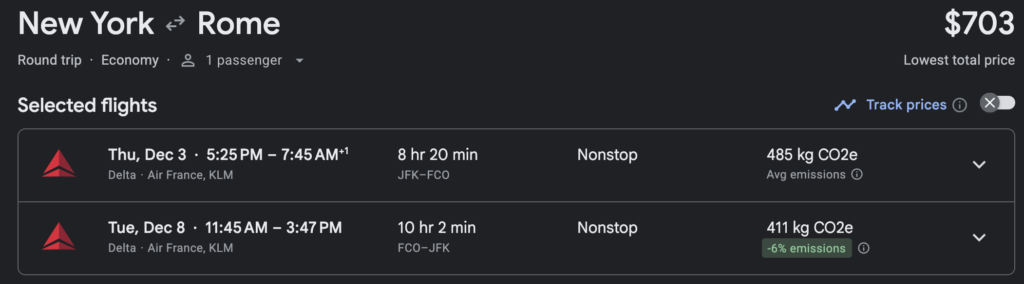
Suppose you want to travel through Italy. You find these two options:
Option A: Traditional Round Trip
New York → Rome → New York
Airfare: $703
Option B: Open Jaw
New York → Rome
Venice → New York
Airfare: $763
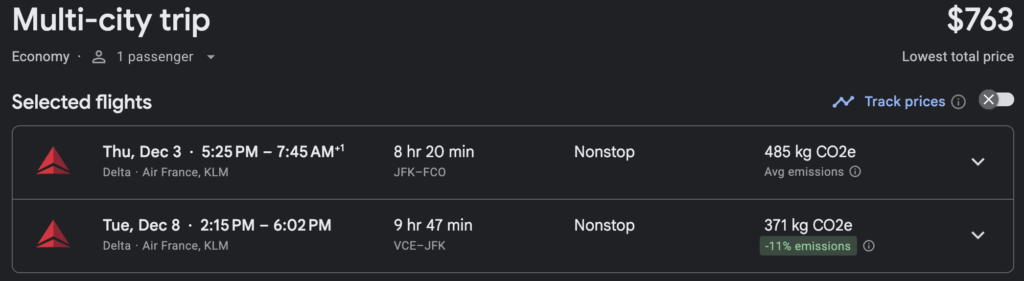
Looking only at airfare, Option A wins by $60. But now consider what happens at the end of the trip. Returning from Venice to Rome might require a train ticket, local transportation and several hours of your final vacation day.
Suddenly the $60 airfare savings doesn’t tell the whole story. Your actual comparison is closer to:
Round Trip = Airfare + Backtracking Cost + Transportation + Time
versus
Open Jaw = Slightly Higher Airfare + Less Backtracking
This is why evaluating flights purely by ticket price can lead to the wrong decision.
Open-Jaw Flights Can Increase Travel Value
This distinction matters because transportation has costs beyond the amount charged to your credit card.
A cheaper itinerary could require:
- Five additional hours on a train
- Another hotel night
- Airport transportation
- An extra positioning flight
- A more stressful final day
- Giving up time you could have spent at your destination
None of those necessarily appear when you’re comparing two airfares, but they absolutely affect the value of the trip. That’s why an open jaw that costs $100 more could still be the less expensive decision in practical terms.
Open-Jaw Flights and Award Travel
Open-jaw itineraries can become particularly interesting when you’re booking with airline miles. For example:
- Newark → Tokyo
- Travel independently through Japan
- Osaka → Newark
Instead of returning all the way to Tokyo simply because that’s where your international trip began, you could continue traveling through Japan and look for an award flight home from Osaka.
However, open-jaw award rules vary by loyalty program.

Some programs explicitly permit certain open jaws, while others impose restrictions based on routing, award type, region or other factors.
For example, Aeroplan’s Flight Reward Policy explicitly allows one-way, round-trip, open-jaw and multi-city award travel. However, Aeroplan also imposes specific routing rules, including that an open jaw cannot occur at a stopover point.
Singapore Airlines’ KrisFlyer rules provide another example. Its current terms permit one origin or destination open jaw on a round-trip award, while prohibiting en-route open jaws and applying other routing conditions.
This is also why you should verify the rules of the specific loyalty program before transferring points.
When Should You Book an Open-Jaw Flight?
Open-jaw itineraries tend to make the most sense when you’re:
- Visiting several cities or countries
- Traveling primarily in one direction
- Trying to avoid backtracking
- Visiting places connected by good rail transportation
- Working with limited vacation time
- Comparing several international gateways
- Using airline miles
- Able to fly from multiple airports
They’re less useful when your vacation is centered around one destination or when getting between your arrival and departure cities creates more inconvenience than it eliminates.
The question isn’t simply: “Can I book an open jaw?”
It’s: “Does an open jaw make this particular trip better?”
Is an Open-Jaw Flight Worth It?
Sometimes, and that’s ultimately the point. Open-jaw flights aren’t a secret trick for beating airline pricing. They’re a tool for designing a more efficient itinerary.
A traditional round trip might have the lowest airfare but require hours of backtracking. Whereas, an open jaw might cost slightly more but save transportation expenses and preserve half a vacation day.
The right comparison therefore isn’t:
Which ticket is cheaper?
It’s:
Which itinerary creates the most value for the entire trip?
That’s a very different question, and sometimes the smartest airfare isn’t the cheapest one.
It’s the one that helps you travel better.