What Is a Positioning Flight? When Flying Somewhere Else First Can Save You Money
Most travelers assume their trip begins at their home airport.
If you live in New York, you search from New York. And if you live in Washington, you search from Washington. If you live in Charlotte, you search from Charlotte. It just makes sense!
But airfare and award availability don’t always cooperate with where you happen to live.
Sometimes the better flight, whether because of price, award availability, schedule, or cabin, departs from another airport entirely.
That’s where a positioning flight comes in.
A positioning flight is a separate flight you take to reach the airport where your primary itinerary begins. It can unlock dramatically better travel options, but it also introduces a risk that many travelers underestimate.
Used correctly, positioning flights can be an incredibly useful booking strategy.
Used poorly, they can turn a great deal into a very expensive mistake.
What Is a Positioning Flight?
A positioning flight is a flight taken primarily to reach the departure airport for another flight. Imagine you live near Newark (EWR) and want to fly to Europe.
You find these options:
| Option A | Option B |
| Newark → Paris | Boston → Paris |
| $1,100 round trip | $650 round trip |
Instead of just paying $1,100 to fly from Newark, you might separately book a flight from Newark → Boston and then begin your international itinerary Boston → Paris.
Your flight from Newark → Boston becomes your positioning flight. This is because you’re essentially repositioning yourself to another airport because the flight you actually want originates somewhere else.
Why Would Someone Take a Positioning Flight?
At first, flying somewhere else before beginning your trip sounds inefficient.
Sometimes it is.
But airline pricing isn’t determined simply by distance. Airlines price individual markets based on factors including demand, competition, available inventory and revenue-management decisions.
That means a flight originating hundreds of miles away could potentially be much cheaper than one from your home airport.
Positioning flights allow you to take advantage of those differences.
There are three major reasons travelers use them.
1. Lower Airfare
Suppose you want to fly business class to Europe. If you find a fare from your home airport, for example, New York → Rome for $3,800, but then find a flight from Boston → Rome for $2,200, it would make a lot more sense to position yourself to Boston to save money.
Hypothetically, if a flight from New York to Boston costs $600, positioning to Boston could theoretically save $1,000. However, one thing to note is that the calculation shouldn’t stop there.
You may also need to consider baggage fees, transportation, meals, potentially a hotel and, most importantly, the additional time and risk involved.
A positioning flight only creates value when the total trip economics still make sense.
2. Better Award Availability
Positioning flights can become particularly useful when booking with airline miles. Award availability isn’t distributed equally across every airport. You may find no business-class award seats from your home airport but discover multiple seats from another gateway.
This becomes particularly useful for many carriers that don’t have hubs in the United States or even partner award availability. Your search results might look like this:
- Newark → Tokyo: No useful business-class award availability
- Chicago → Tokyo: Business-class award availability
Then, you could potentially book a separate Newark-to-Chicago flight and then redeem your miles from Chicago.
By doing this, you are able to significantly expand the number of flights you can search rather than limiting yourself to whichever long-haul routes happen to leave from your home airport.
It’s one reason tools that search award availability across multiple airports can be so valuable.
3. Access to Different Airlines or Aircraft
As slightly mentioned above, sometimes a positioning flight isn’t about saving money at all. It can give you access to an airline, route or K that doesn’t serve your home airport.
Perhaps the product you want operates from Los Angeles but not San Francisco. Or an airline offers significantly better award availability from Washington than New York.
You might even position because another airport offers a nonstop flight that eliminates a connection later in the journey. In these situations, the positioning flight is effectively the cost of accessing a better itinerary.
Positioning Flights vs. Connecting Flights
The distinction between these two is very important. A connecting flight is generally part of the same itinerary.
Take the below example:
Newark → Minneapolis → Tokyo
The entire itinerary is booked through Delta and both flights are booked together on one ticket, so Minneapolis is simply your connecting airport.
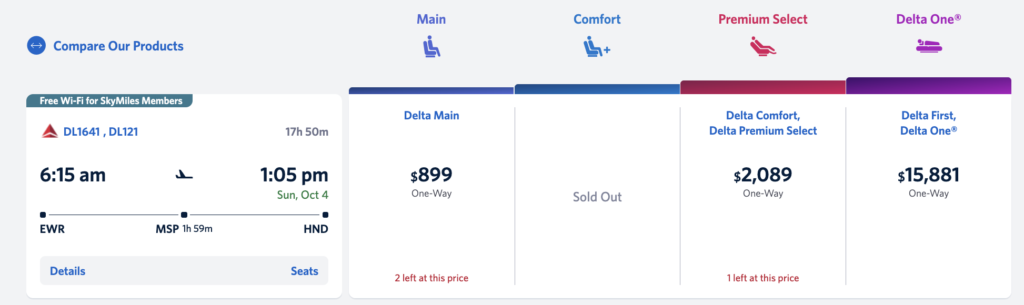
Where the strategy changes, is that instead of the above, your positioning strategy might instead look like:
- Ticket #1: Newark → Minneapolis
- Ticket #2: Minneapolis → Tokyo
The flights may look almost identical on paper.
But operationally, they’re very different. With separate tickets, the airline operating your second itinerary may have no obligation to accommodate you if your positioning flight arrives late and causes you to miss the next flight.
That is the biggest risk of positioning flights.
The Biggest Positioning Flight Risk: Separate Tickets
Imagine you’ve booked an incredible business-class award flying out of Chicago. The only thing is that you’re based in the New York/ Newark area. So you effectively need to build an itinerary to get to Chicago before your award flight departs.
- Chicago → Tokyo– departure 12:30pm
You then separately book a flight from Newark → Chicago, which is scheduled to arrive at 10:00 a.m. That gives you enough time to A two-and-a-half-hour connection might look reasonable.
Until your first flight is delayed.
If you arrive in Chicago at 1:00 p.m., you’ve missed the flight that actually mattered.
Because the two flights were booked separately, you generally don’t have the same protections you would have if both segments were issued as one itinerary.
Your $120 positioning flight could jeopardize a much more valuable international ticket.
That’s why positioning flights should be evaluated based on risk, not just price.

How Much Time Should You Leave Between Positioning Flights?
There really isn’t one universal rule. Generally speaking, there are Minimum Connection Times (MCT), which can provide a good baseline, but there are other factors you should be aware of.
The appropriate buffer depends on:
- How valuable the primary ticket is
- Whether you’re checking luggage
- Airport size and terminal changes
- International check-in requirements
- Frequency of alternative flights
- Weather and seasonal disruption risk
- Whether the positioning route has multiple flights per day
For an inexpensive domestic trip, you might tolerate more risk. However, for a difficult-to-replace international business-class award, the calculation changes completely.
In many cases, positioning the night before can be the smarter strategy.
Yes, that could mean paying for a hotel, but spending $150 on a hotel may be reasonable insurance when you’ve built an entire international trip around an award seat that’s extremely difficult to replace.
Checked Bags Make Positioning More Complicated
Separate tickets can also complicate baggage.
You shouldn’t automatically assume an airline will check your bag through to your final destination when your flights are booked on separate reservations.
Depending on the airlines and itinerary, you may need to:
- Arrive at the positioning airport.
- Collect your checked luggage.
- Travel to the appropriate departure area or terminal.
- Check in with the next airline.
- Recheck your luggage.
- Clear security again.
For an international flight, that can make a tight positioning connection particularly risky. One way to alleviate this is by traveling with carry-on luggage to make positioning substantially easier, but might not always be possible.

When Is a Positioning Flight Worth It?
Positioning flights make the most sense when the improvement to your primary itinerary is significant.
Consider a hypothetical comparison:
| From Home Airport | Positioning Option | |
|---|---|---|
| Long-haul airfare | $3,500 | $2,100 |
| Positioning flight | — | $150 |
| Hotel | — | $175 |
| Additional transportation | — | $50 |
| Estimated total | $3,500 | $2,475 |
| Potential savings | — | $1,025 |
Suddenly, adding another flight doesn’t look quite as irrational. But change the $2,100 airfare to $3,000 and the equation becomes much less compelling.
However, maybe only saving $125 after adding another flight, hotel stay and additional travel time probably isn’t worth it.
The airfare savings aren’t the same thing as the trip savings.
How to Search for Positioning Flight Opportunities
Start by searching your normal itinerary from your home airport. Then broaden the search to major airports that you could reasonably reach.
For international travel from the United States, that might mean comparing several major gateways rather than searching only your nearest airport.
Say you’re near
The goal isn’t to randomly search every airport in the country.
You’re looking for a meaningful difference, a significantly lower airfare, much better award availability, a superior nonstop, or access to a product you couldn’t otherwise book.
Once you find one, price the positioning itinerary separately and calculate the entire cost.
Don’t compare:
$900 vs. $600.
Compare:
$900 from home vs. $600 + positioning flight + hotel + transportation + baggage costs + additional time.
Because that’s the comparison that actually matters.
Positioning Flights for Award Travel
Positioning can be especially powerful for award travel because premium-cabin award availability is often much harder to find than paid airfare.
Instead of searching only:
Newark → Europe
you might search long-haul availability from:
New York, Boston, Washington, Chicago, Philadelphia or other major gateways.
If an excellent redemption appears elsewhere, you can then determine whether positioning to that airport makes sense.
This flips the normal booking process around.
Instead of asking:
“What award flights leave from my airport?”
You’re asking:
“Where is the valuable award availability, and can I reasonably get there?”
For flexible travelers, that’s a much larger search universe.
Should You Book the Positioning Flight First?
Usually, the valuable or difficult-to-replace part of the itinerary should drive the decision.
If you’ve found rare premium-cabin award availability, securing the long-haul itinerary may be more important than immediately booking the relatively ordinary domestic positioning flight.
But before committing, verify that reaching the departure airport is realistic.
Check:
- positioning flight schedules,
- typical fares,
- alternative flights,
- airport transfer requirements,
- hotel availability if needed,
- and how much buffer you realistically need.
A fantastic redemption isn’t fantastic if getting to the departure airport creates an unreasonable itinerary.
Positioning Flights Aren’t Always Worth It
There’s a temptation in points-and-miles travel to optimize everything.
Sometimes the smarter decision is simply paying more.
If your choices are either $850 nonstop from your home airport or $700 after positioning, with two additional flights and six extra hours of travel…
the $850 ticket may provide substantially more value.
Positioning becomes compelling when the difference is meaningful enough to justify the inconvenience and risk.
That could mean saving $1,000. It could also mean finding two business-class award seats that aren’t available anywhere near home. Or it could mean accessing a nonstop route that dramatically improves the trip.
There doesn’t need to be a universal threshold, there needs to be a reason.
The Fare Theory
A positioning flight is ultimately a trade.
You’re accepting additional complexity in exchange for something valuable: lower airfare, better award availability, a better airline, a better cabin or a better route.
Sometimes that trade is absolutely worth making.
Other times, travelers spend hours repositioning themselves around the country to save an amount that barely covers the additional inconvenience.
The goal shouldn’t be to find the cleverest itinerary. It should be to find the itinerary that creates the most overall value.
Points are renewable. Time is not.