Why I Redeemed 147,500 KrisFlyer Miles at Just 1.33 Cents Per Mile
When booking a flight from Bali to Tokyo, I faced a decision familiar to points-and-miles travelers: How should I think about KrisFlyer miles value…by maximizing cents per point, or by maximizing the value of the trip itself?
I had several options. I could reposition from Bali to Singapore and redeem fewer miles for business class. I could fly economy and preserve most of my KrisFlyer balance. Or I could spend 147,500 KrisFlyer miles per person to fly from Bali to Tokyo in business class on a single itinerary.
I chose the expensive option.
I had several options. I could reposition from Bali to Singapore and redeem fewer miles for business class. I could fly economy and preserve most of my KrisFlyer balance. Or I could spend 147,500 KrisFlyer miles per person to fly from Bali to Tokyo in business class on a single itinerary.
I chose the expensive option.
On paper, it wasn’t the best redemption. Once I accounted for time, convenience, positioning risk, comfort and the overall travel experience, however, I thought it offered the best travel value.
And I’d make the same decision again.
That distinction is important because cents per point (CPP) doesn’t tell you whether you made the best travel decision. It only tells you how much cash value you received for each point or mile redeemed.
For this trip, the option with the highest CPP wasn’t necessarily the option that created the most value.
The Three Bali-to-Tokyo Award Options I Considered
Our trip was taking us from Bali to Tokyo on fixed dates, which made the decision a balance between three things: miles, comfort and time.
After comparing the available options, I narrowed the decision to three general strategies:
| Option | Miles Per Person | Approx. CPP | Primary Tradeoff |
|---|---|---|---|
| Singapore → Tokyo Business | 104,000 | ~2.21¢ | Requires positioning from Bali |
| Bali → Tokyo Business | 147,500 | ~1.33¢ | Highest mileage cost |
| Bali → Tokyo Economy | 27,000 | ~1.42–1.77¢ | Less comfort / itinerary tradeoffs |
The first option initially looked particularly attractive, but there was just one problem.
We weren’t in Singapore, we were in Bali.
And once I started accounting for what it would actually take to position ourselves to Singapore, the simple CPP comparison became much less useful.
Option 1: Singapore to Tokyo in Business Class
This was initially one of the strongest options.
Singapore Airlines offers multiple flights between Singapore and Tokyo, including service to both Haneda and Narita. For our purposes, either Tokyo airport worked because we weren’t in a rush to reach central Tokyo immediately after landing.
Business-class award availability from Singapore to Tokyo was available at 104,000 KrisFlyer miles per passenger for the award option we were considering. Since we would want a confirmed booking, the 80,500 mile redemption waitlist was not an option.

The comparable cash fare was approximately S$2,931 ($2,294 USD) per passenger when I searched. Redeeming 104,000 KrisFlyer miles for the same flight produced a redemption value of approximately 2.21 cents per point.
At 2.21 CPP, this was a strong redemption on paper. But as I’ll explain, maximizing CPP wasn’t necessarily the same thing as maximizing the overall value of the trip.
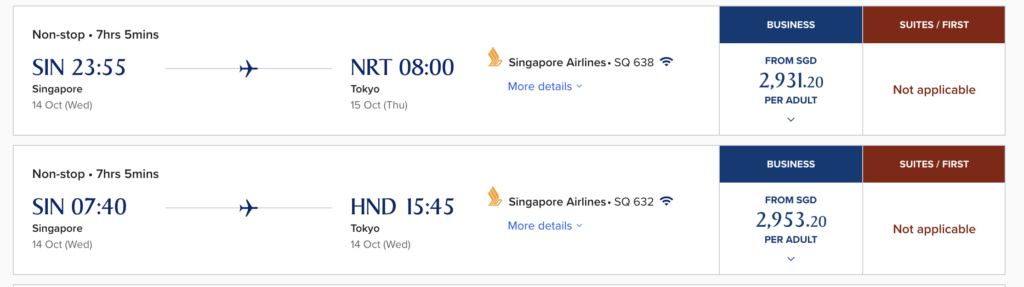
If I were evaluating the decision exclusively through cents per point, this would have been difficult to beat. But there was a major flaw in that calculation.
Singapore Airlines priced the confirmed business-class award at 104,000 KrisFlyer miles per passenger, based on its KrisFlyer award pricing.
The Positioning Flight Changes the Economics
Our trip wasn’t starting in Singapore. It was starting in Bali. Booking Singapore-to-Tokyo separately meant we’d first have to get ourselves from Denpasar to Singapore. Suddenly, the real comparison wasn’t 104,000 miles vs. 147,500 miles.
It was:
104,000 miles + positioning flight + additional travel time + separate-ticket risk + additional complexity
versus
147,500 miles on one protected itinerary from Bali to Tokyo.
That’s a very different calculation.
Separate tickets can also introduce additional baggage and disruption considerations. Singapore Airlines itself notes that baggage treatment differs for separate tickets and warns that passengers may need additional time to collect baggage, clear immigration and re-check for an onward flight when through-checking isn’t available.
This is where traditional CPP calculations start to break down, because the 2.21 CPP figure was real, but it wasn’t measuring the entire trip.
Option 2: Bali to Tokyo in Business Class
The second option was much simpler: book the entire journey from Bali to Tokyo through Singapore on one itinerary.
From a travel perspective, this was immediately appealing.
No separate positioning ticket. No building a large connection buffer in Singapore. No worrying about what would happen to the second ticket if the positioning flight were significantly delayed.
And our checked baggage could travel as part of the same itinerary rather than us constructing the journey ourselves.
Singapore Airlines generally transfers checked baggage to the onward flight when connecting on an eligible single itinerary.
There was one significant downside:
147,500 KrisFlyer miles per passenger, which is 295,000 miles for two people.

I hadn’t even spent that many miles per person booking Singapore Airlines’ famous ultra-long-haul service from Newark to Singapore.
So I had to ask myself:
Could I actually justify spending that much?
The comparable Singapore Airlines business-class itinerary was selling for approximately 31.9 million IDR, or about $1,960 USD per passenger, when I searched.

Using the simple CPP formula:
$1,960 ÷ 147,500 = approximately 1.33 cents per point.
That’s not terrible, but 1.33 CPP isn’t the type of redemption that points enthusiasts typically brag about. And compared with the approximately 2.21 CPP available from Singapore, it looked even worse.
That made the third option particularly important.
Option 3: Bali to Tokyo in Economy
From a pure miles-preservation perspective, economy may have been the smartest choice. Singapore Airlines had economy award availability for approximately 27,000 KrisFlyer miles per passenger on options I considered.
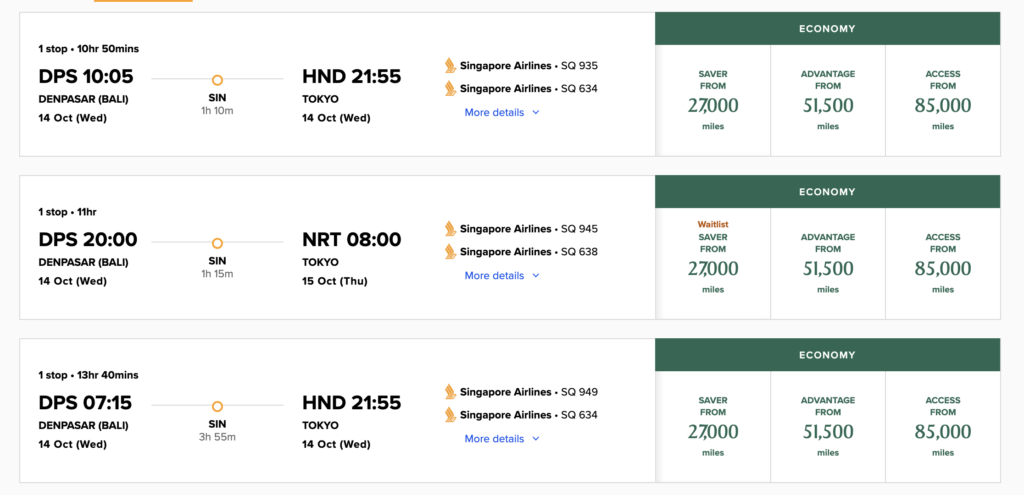
Cash fares for the itineraries I considered were approximately $384–$477 per person, based on the exchange rate at the time. Against a 27,000-mile Saver award, that produced approximately 1.42–1.77 cents per mile in redemption value.
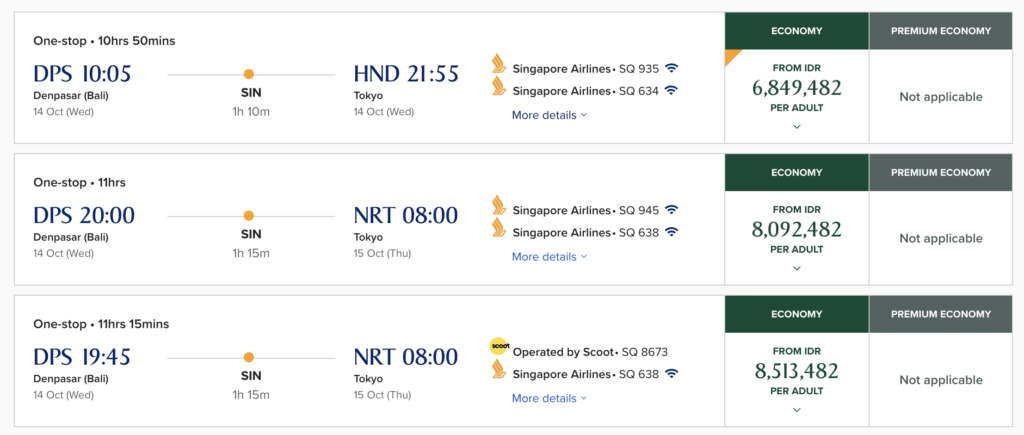
Some alternative itineraries involving Scoot could produce an even higher theoretical return, although those weren’t directly equivalent to the Singapore Airlines itinerary I ultimately wanted.
And that’s an important distinction.
CPP comparisons are only useful when you’re comparing travel products you would realistically purchase.
A $5,000 business-class ticket doesn’t automatically mean you’ve received $5,000 of personal value just because an airline was selling it for that amount.
Likewise, an inconvenient itinerary isn’t necessarily better simply because it produces another 0.5 cents per mile on a spreadsheet.
If my only objective were preserving my KrisFlyer balance while extracting reasonable value from my miles, economy probably would have won.
But maximizing my mileage balance wasn’t my objective.
Maximizing the value of a finite vacation was.
The Hidden Cost of “Saving” Miles
This is where The Fare Theory differs from traditional points-and-miles thinking.
There are far more variables involved in a booking decision than simply maximizing cents per point.
Miles are a currency controlled by the loyalty program issuing them. Award pricing, availability and redemption structures can change over time.
Singapore Airlines, for example, maintains different redemption structures and conditions for KrisFlyer awards, with different change and cancellation rules depending on the award type.
That doesn’t mean you should recklessly burn points.
But it does mean that accumulating the largest possible balance shouldn’t necessarily be the objective.
More importantly:
Points are renewable. Time is not.
Travelers can become obsessed with squeezing every last fraction of a cent from their points balances.
- We search alternate airports.
- We position to different cities.
- We accept longer connections.
- We spend hours searching award calendars.
And sometimes, those strategies make tremendous sense. But sometimes we optimize the spreadsheet at the expense of the actual trip.
And travel doesn’t happen on a spreadsheet.
CPP vs. Travel Value
CPP answers a very specific question:
How much cash value am I receiving for every point or mile redeemed?
While it can be incredibly useful, there’s one big question it doesn’t answer:
Which itinerary creates the most value for my trip?
Those are different questions. For The Fare Theory, I think about travel value more broadly:
- Redemption Value- How much reasonable cash cost am I replacing with points?
- Time Value- How much vacation time does the itinerary consume?
- Convenience- Does the itinerary simplify the trip or introduce additional steps?
- Positioning Risk- Am I creating separate-ticket connections that could become my responsibility if something goes wrong?
- Comfort- How much do I actually value the difference between economy, premium economy and business class on this particular journey?
- Opportunity Cost- What else could I do with the additional miles?
Put together, the decision looks more like:
Travel Value = Redemption Value + Time + Convenience + Comfort − Risk − Opportunity Cost
It isn’t meant to produce a universal numerical score, it’s actually a decision framework. And that’s the distinction that ultimately determined what I booked.
Why I Ultimately Spent 147,500 KrisFlyer Miles
Once I stopped asking “Which redemption gives me the highest CPP?” and instead asked “Which option creates the best trip?”, the decision became much easier.
The 147,500-mile business-class redemption gave us several things I valued:
- One itinerary from Bali to Tokyo
- A protected connection through Singapore
- Checked baggage handled as part of the itinerary
- Business-class comfort
- Less logistical complexity
- An itinerary that worked with our existing vacation schedule
Could we have spent fewer miles? Absolutely.
Could we have generated a higher CPP? Also yes.
But both alternatives required giving something else up. The Singapore-originating business-class redemption saved miles but required us to position from Bali.
The economy redemption preserved a huge portion of our KrisFlyer balance but sacrificed the premium-cabin experience and, depending on the itinerary selected, could affect how we wanted to structure that travel day.
The 147,500-mile redemption wasn’t mathematically optimal.
It was trip-optimal.

Was 1.33 Cents Per KrisFlyer Mile a Bad Redemption?
I don’t think so. And this is where I’d be careful about labeling redemptions universally as “good” or “bad.” Third-party points publications publish benchmark valuations for loyalty currencies. TPG, for example, currently values KrisFlyer miles at 1.3 cents each. Those valuations can be useful reference points.
But a theoretical valuation doesn’t know:
- how much vacation time you have,
- whether you’re traveling with checked baggage,
- how much you value business class,
- whether you’re comfortable booking separate tickets,
- what your points balance looks like,
- or what alternatives were available on your exact dates.
That’s why I’d rather ask:
What did spending the additional miles actually buy me?
In this case, they bought more than a business-class seat.
They bought simplicity.
They bought protection against some of the complexity of separate tickets.
They bought comfort.
And most importantly, they helped us structure the journey around the vacation rather than structuring the vacation around the redemption.
That’s worth something.
The Fare Theory: Optimize the Trip, Not the Spreadsheet
Spend enough time in points-and-miles circles and you’ll quickly learn that everyone loves talking about CPP. And I understand why.
It’s simple, it’s measurable, and honestly, it makes different redemptions relatively easy to compare. But travelers can become so focused on maximizing that number that they forget why they’re traveling in the first place.
A redemption isn’t just math.
It’s time, convenience, stress, comfort, risk and the overall experience.
For my Bali-to-Tokyo flight, spending 147,500 KrisFlyer miles per person for approximately 1.33 cents per mile wasn’t the highest-value redemption available according to traditional CPP.
And I’m completely comfortable with that.
- Was it the highest CPP redemption available? Nope.
- Would I book it again? Absolutely.
Because points are a tool for improving travel, not a score you’re supposed to maximize.
And that’s exactly what The Fare Theory is about.