United’s 2027 Status Changes Make Loyalty More Expensive for Frequent Flyers
Flying frequently and being a valuable airline customer aren’t always the same thing. United status requirements 2027 are changing, and frequent flying alone will carry less weight.
United’s changes to Premier qualification beginning in 2027 make that increasingly clear. The airline is removing the option to qualify through a combination of Premier qualifying flights and Premier qualifying points, leaving a points-based qualification system. It is also increasing the points-only requirement for Premier 1K.
For travelers who previously qualified by taking plenty of flights while meeting the lower spending threshold, that represents a meaningful change.
The question is whether maintaining the same status will still justify the additional cost. As we explain in “Is Airline Elite Status Worth It?“, benefits should be evaluated against what you give up to earn them including money, time, and flexibility.
United’s latest changes make that calculation more important.
What Is Changing With United Premier Qualification in 2027?
United has historically offered two qualification paths: earn a combination of Premier qualifying flights, or PQF, and Premier qualifying points, or PQP; or reach a higher PQP-only threshold.
Beginning in 2027, the combined path is being removed. The reported requirements as follows:
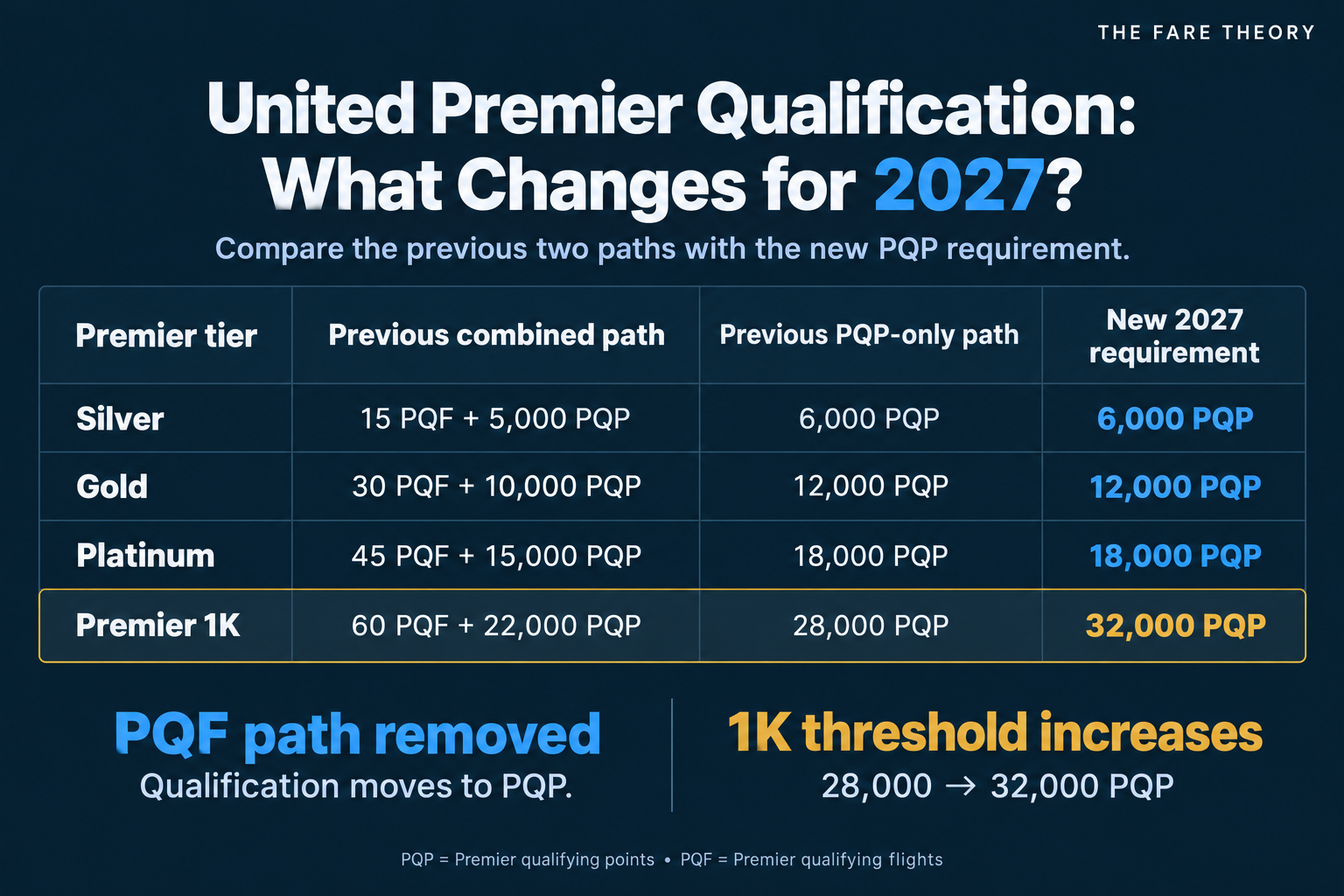
Members will still need at least four United or United Express flights. These are qualification requirements for activity during 2027; they do not retroactively change the thresholds for activity during 2026.
PQP should not be confused with redeemable MileagePlus miles or the total amount charged for a ticket. United’s booking information explains that flight earnings are calculated using eligible base fares and applicable carrier-imposed surcharges.
The Increase Depends on How You Previously Qualified
Calling this a uniform increase across the board would be considered a miscalculation. Someone already qualifying for Gold through the 12,000-PQP route faces the same headline threshold. Someone qualifying through 30 flights and 10,000 PQP loses access to that lower points requirement.
Using the thresholds above, the difference looks like this:
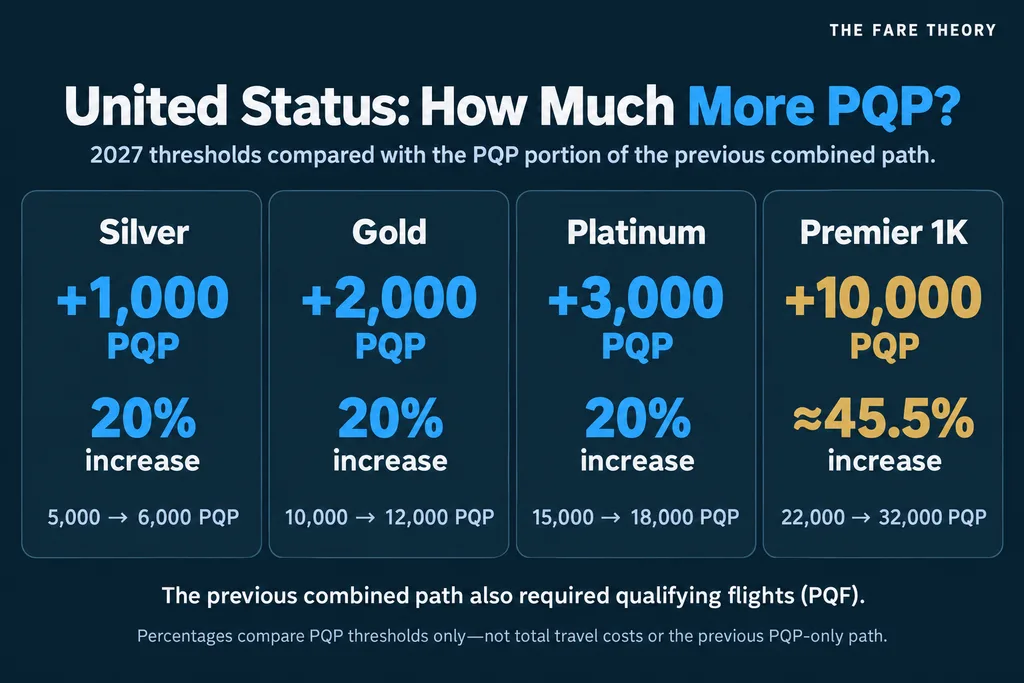
For those travelers, flying the same schedule and earning the same PQP could produce a lower status level. That is the practical significance of removing the flight-based qualification path: the flights themselves no longer unlock a lower points target.
Frequent Travel and High Spending Are Different Behaviors
Consider two hypothetical customers.
- One takes frequent, relatively inexpensive domestic trips
- The other flies less often but purchases more expensive tickets.
The first traveler may spend more days in airports and have a stronger personal sense of loyalty. The second may generate more ticket revenue. Our general interpretation of United’s change is that the program is making the second behavior more decisive.
That can be commercially understandable while still disappointing frequent flyers. A loyalty program is designed to influence customer behavior, and an airline can choose to place greater weight on spending than on how often someone boards its aircraft.
The traveler’s responsibility is to decide whether responding to that incentive still makes sense.
The Biggest Risk Is Paying More to Preserve Familiar Benefits
Once you have status, maintaining it can feel like protecting something you already own. You become accustomed to priority services, better seat access, and the possibility of an upgrade. Losing those benefits feels more concrete than the money gradually spent keeping them.
That is the behavior explored in an article we wrote titled “The Endowment Effect in Airline Loyalty“…familiarity and ownership can make switching airlines feel like a loss.
Higher qualification requirements create another opportunity for that attachment to influence spending. Perhaps you choose a more expensive United itinerary. Perhaps you accept a connection instead of a nonstop. Perhaps you book a trip you otherwise would have skipped.
Each decision can appear reasonable individually. Together, they become the price of maintaining status.
Calculate the Cost of Closing the Gap
Suppose your planned travel leaves you short of your desired tier.
The useful question is:
How much additional value would that tier provide compared with the status you would earn naturally?
Imagine that maintaining a higher tier requires $1,200 in additional spending you would otherwise avoid. You estimate the extra benefits are worth $600 over the following year.
If that spending provides no other value to you, maintaining the higher tier leaves you $600 worse off.
The relevant comparison is incremental. If you would earn Silver without changing your plans, compare the additional value of Gold against Silver. Don’t assign Gold credit for benefits you would already receive at the lower tier.
Also consider alternatives. Paying for extra legroom on occasional flights may cost less than changing your annual travel behavior to secure better seating through status.
Can Credit Card Spending Help Close the Gap?
Eligible United credit cards provide another way to earn PQP through everyday spending.
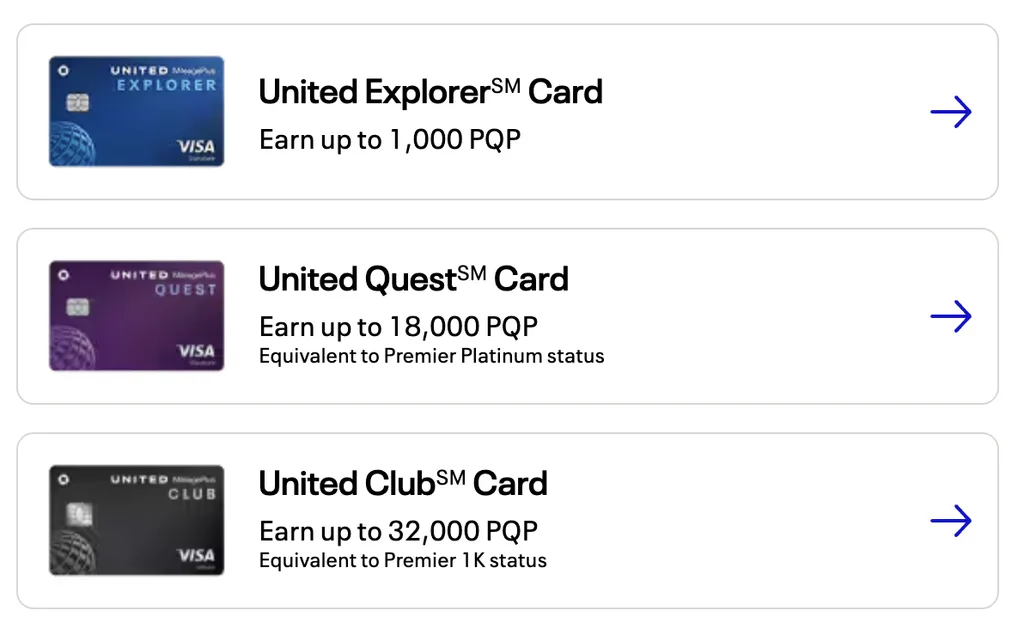
However, the amount charged to the card isn’t necessarily the cost of pursuing status. If you redirect purchases you already planned to make, the main cost is the difference between the rewards earned on your United card and what you could have earned elsewhere, plus any additional annual fee.
For example, suppose shifting existing purchases to a United card helps you reach the next tier but means giving up $200 in other rewards. If the additional status benefits are worth $600 to you, that could be a reasonable trade. Spending extra money on purchases you don’t need creates a different calculation. Earning PQP doesn’t make those purchases worthwhile.
The limits shown above are maximum earning amounts, not automatic PQP deposits. Card spending requirements and program terms apply, and members must still satisfy United’s minimum-flight requirement.
The goal is to close the gap at a cost below the additional value the higher tier provides.
Don’t Let Upgrades Carry the Entire Calculation
Potential upgrades can make a higher tier feel especially valuable. But a possible upgrade should not be treated like a benefit you are certain to receive.
Even when an upgrade clears, its personal value depends on the flight. A wider seat on a short regional hop and a more comfortable experience on a longer journey do not deliver equal value simply because both involve moving forward in the cabin.
That distinction is central to getting a free update, but in reality, it barely mattered. When estimating the value of status, use what you would reasonably pay for the benefits you expect to use. A premium cabin’s advertised price is not automatically your savings.
The Fare Theory Take: Requalifying Is a New Purchase Decision
United’s 2027 changes will affect travelers differently. Some will reach their usual tier without changing their behavior. Others will face a larger gap.
For that second group, the response should begin with a fresh calculation.
Last year’s loyalty does not obligate you to spend more next year. The flights already taken and the effort already invested cannot make an unattractive future purchase worthwhile.
Build your travel plans first. Estimate the status those plans would naturally produce. Then evaluate whether moving higher would deliver enough additional value to justify the cost.
An airline can raise the price of loyalty. You still get to decide whether to buy it.