What Is Dynamic Pricing? How Airlines Change Ticket Prices
How Traditional Airline Pricing Works
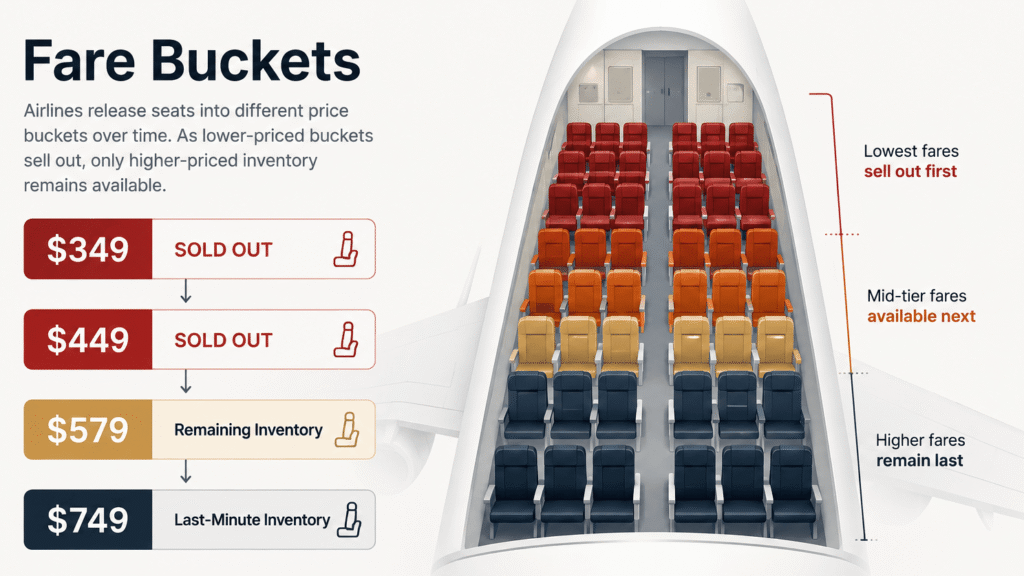
To understand dynamic pricing, it helps to understand the system that came before it. Airlines traditionally divide their inventory into different booking classes, sometimes called fare buckets.
A simplified economy cabin might contain inventory associated with prices such as:
$249 → $329 → $429 → $579 → $749
The airline doesn’t necessarily make every seat available at every price. Instead, its revenue-management system controls how much inventory is available within different booking classes.
If the $249 inventory becomes unavailable, the cheapest available ticket might suddenly become $329.
From the traveler’s perspective, the ticket price increased by $80. But the airline didn’t necessarily dynamically calculate a brand-new $329 price for that passenger.
The cheaper fare may simply no longer have been available. This is why understanding how airline fare buckets work is important when interpreting airfare changes.
So What Makes Pricing “Dynamic”?
Dynamic pricing introduces more flexibility into the price-setting process.
Rather than relying exclusively on a relatively fixed collection of predefined fares, a more dynamic system can adjust the offer presented to a traveler as conditions change.
Imagine a flight with an economy ticket selling for $500. Demand begins increasing faster than expected.
A traditional system might close the $500 booking class and move availability into a predefined $575 fare. A more dynamic pricing system could potentially generate an offer somewhere between those traditional price points.
For example it might fall within one of these pricing pillars: $500 → $527 → $551 → $575.
The exact implementation varies significantly by airline and technology platform. The important distinction is the increased ability to adjust the actual offer rather than simply opening and closing predetermined fare buckets.
What Factors Can Influence Dynamic Airline Pricing?
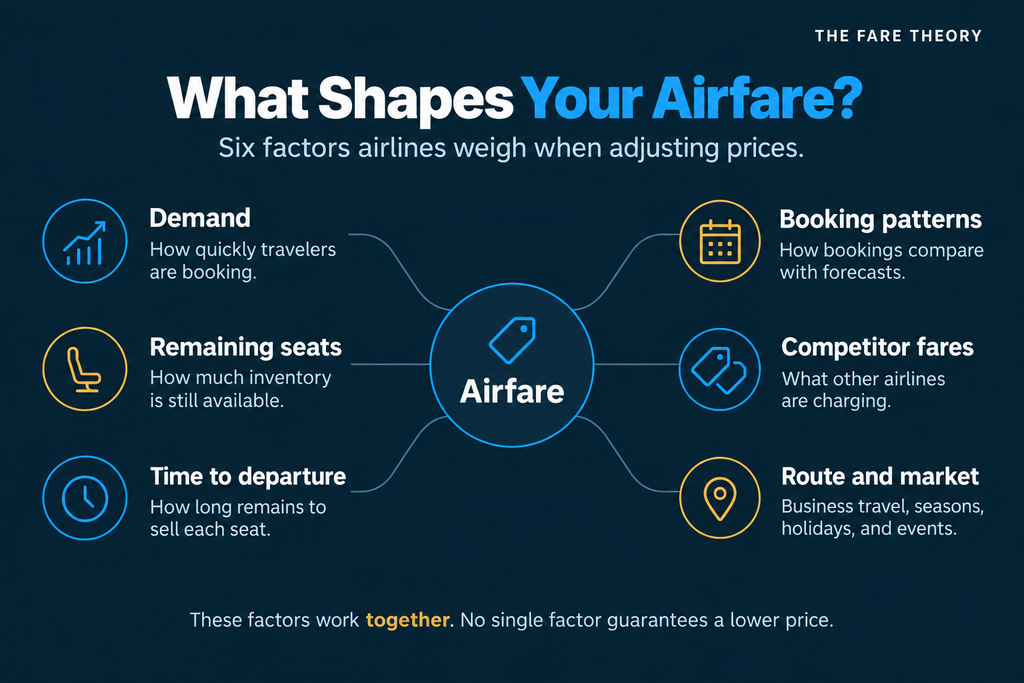
Airline pricing systems can consider enormous amounts of information. Some of the most important factors include:
- Demand- If bookings are arriving faster than expected, the airline may have less reason to offer lower prices. Weak demand can create the opposite incentive.
- Remaining Seat Inventory- A flight with 120 empty seats presents a very different revenue problem from a flight with six empty seats. The closer the flight gets to capacity, the more carefully the airline may manage its remaining inventory.
- Time Until Departure- The value of an empty airline seat disappears once the aircraft departs. That makes airline inventory unusually perishable.
- Booking Patterns- Airlines can compare current bookings with historical patterns and forecasts for similar flights.
- Competitive Pricing- If several carriers compete for the same passengers, changes in competitors’ fares can influence pricing decisions.
- Route and Market Conditions- Business-heavy routes, leisure destinations, holidays, major events and seasonal demand can all create different pricing environments.
Modern airline pricing is the result of systems constantly evaluating how these variables interact.
Dynamic Pricing vs. Revenue Management
These concepts are closely connected, but they aren’t interchangeable.
Revenue management is the broader discipline of forecasting demand and managing inventory to maximize the revenue generated by a flight.
Dynamic pricing concerns how flexibly the price or offer itself can change.
A simplified way to think about it is:
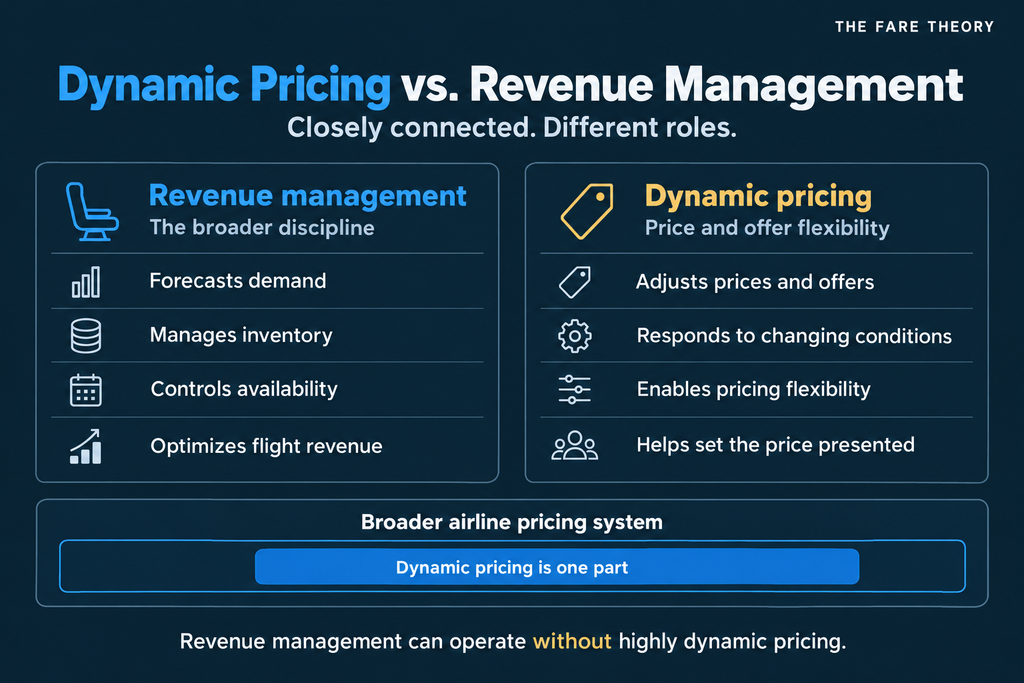
An airline can use revenue management even without highly dynamic pricing. In fact, airlines have been changing the availability of different fares for decades.
Dynamic pricing is therefore best understood as one part of a much larger pricing system. Our guide to airline revenue management explains how airlines forecast demand and decide how much inventory to make available at different prices.
Why Do Flight Prices Change So Often?
This is where several airline-pricing concepts collide. Suppose you search for a flight and see on Monday it costs $349, then you search a few days later and see the price has increased to $429…
Several things could have happened.
- The cheaper booking class may have sold out.
- The airline may have restricted lower-priced inventory.
- Demand may have changed.
- A pricing system may have recalculated the available offer.
- A competitor may have changed its fare.
Or some combination of those factors may be responsible.
That’s why saying “the airline raised the price because more people searched for the flight” is usually far too simplistic. A price change tells you that the available offer changed. It doesn’t necessarily tell you exactly why.
Does Searching for a Flight Make the Price Go Up?
This is one of the most persistent beliefs about airfare.
It feels personal, but correlation doesn’t establish that your individual search caused the increase. Airfares can change while you’re shopping because inventory and pricing conditions are changing at the same time.
If lower-priced inventory disappears between searches, the next search can legitimately return a higher fare.
That can happen regardless of whether you’ve searched once or twenty times.
Dynamic pricing makes airline offers more flexible, but that shouldn’t automatically be interpreted as proof that an airline increased a fare specifically because it recognized you as an interested buyer.
Does Dynamic Pricing Mean Everyone Pays a Different Price?
Not necessarily as dynamic pricing creates the ability to produce more flexible offers. However, that doesn’t mean every passenger receives an individually calculated price.
Airlines can still sell identical tickets at identical prices to many travelers.
And passengers on the same flight have long paid dramatically different amounts even under traditional fare-bucket systems.
- One traveler may book months in advance when inexpensive inventory is available.
- Another may book several days before departure when only expensive fares remain.
They could ultimately sit beside each other.
Same aircraft. Same cabin. Same destination. Very different price.
That’s one of the defining characteristics of airline economics.
IATA’s explanation of dynamic airline pricing reinforces this distinction: airlines can adjust offers using factors such as departure timing, competition, and remaining capacity without necessarily needing personal information about the traveler.

Does Dynamic Pricing Make Flights More Expensive?
Not inherently, and this is because a system capable of raising prices dynamically can also lower them. If demand is weaker than expected, an airline still has an incentive to attract additional passengers.
Remember the fundamental problem airlines face:
An empty seat becomes worthless once the aircraft departs.
The airline is therefore balancing two risks. Price too low and it may sell seats for less than passengers would have paid. But, if they price too high, it may depart with inventory that generates no revenue at all.
Dynamic pricing is another tool for navigating that trade-off.
Can You Predict Dynamic Airline Prices?
Not reliably. There are a number of items you can do to monitor prices such as:
- Observe patterns.
- Compare dates.
- monitor fares.
- use historical pricing information.
But you generally don’t know the airline’s current demand forecast, future bookings or inventory-management decisions. That makes waiting for a specific price inherently uncertain.
A $600 ticket could fall to $500, however it could also rise to $800. There isn’t a universal rule saying that airfare always gets cheaper, or more expensive, on a particular day.
That’s why the best time to book a flight is better approached as a decision under uncertainty than as a hunt for a secret day when airlines supposedly lower prices.
What Dynamic Pricing Means for Travelers
The biggest lesson isn’t that you need to outsmart an airline’s algorithm…let’s be honest, you probably can’t. Instead, dynamic pricing changes how you should think about the price in front of you.
A fare isn’t necessarily a permanent price attached to a particular seat. It’s an offer available under the conditions that exist at that moment.
Those conditions can change.
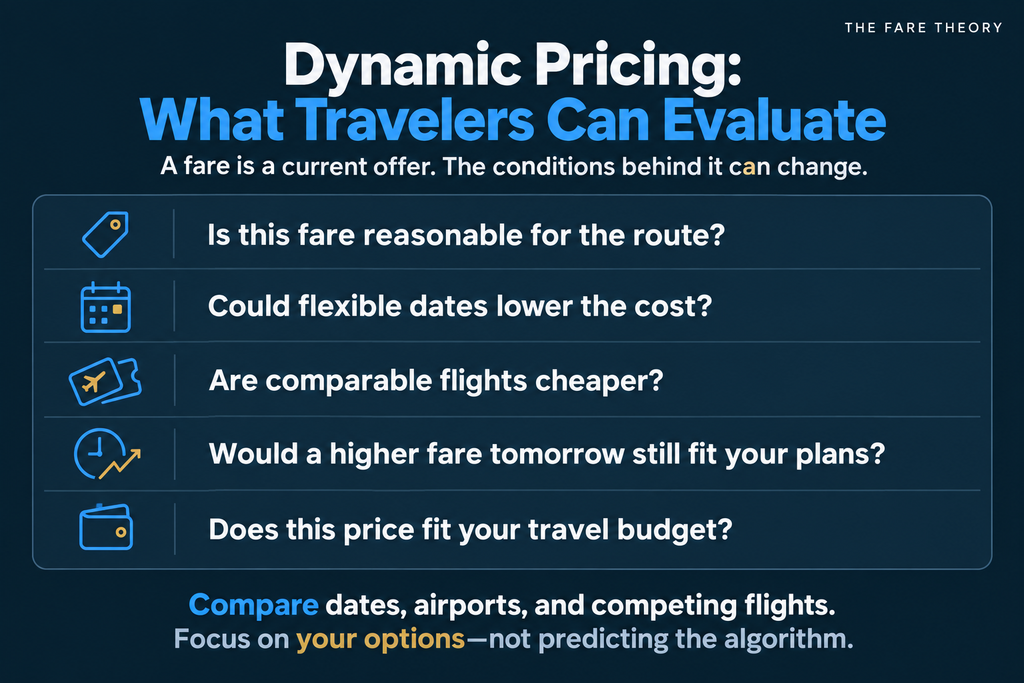
That means travelers should focus on things they can actually evaluate:
- Is the current fare reasonable for this route?
- How flexible are your dates?
- Are comparable flights cheaper?
- Would you still be comfortable booking if the fare increased tomorrow?
- Does the current price fit your travel budget?
Tools that compare dates, airports and competing flights can therefore be more useful than trying to predict exactly what an airline’s pricing system will do next. Rather than trying to reverse-engineer the algorithm, tools like Google Flights can help you compare airfare across dates and competing flight options.
The Bottom Line
Dynamic pricing gives airlines more flexibility to change the prices and offers presented to travelers as market conditions evolve, but it isn’t the only reason airline tickets change price.
Traditional fare buckets, booking classes, inventory controls and revenue-management decisions can all change the cheapest fare available for a flight.
Revenue management determines how airlines manage the economic value of their inventory. Dynamic pricing gives them greater flexibility in how that inventory can be priced.
For travelers, the practical lesson is simpler:
- Don’t assume today’s airfare is permanent.
- Don’t assume tomorrow’s will be cheaper.
- And don’t assume every price change means the airline is responding specifically to you.
Airline pricing is a constantly changing inventory problem, and the fare displayed on your screen is simply the current output of that system.