What Is Seat Pitch? How Airline Legroom Is Actually Measured
What Does Seat Pitch Mean?
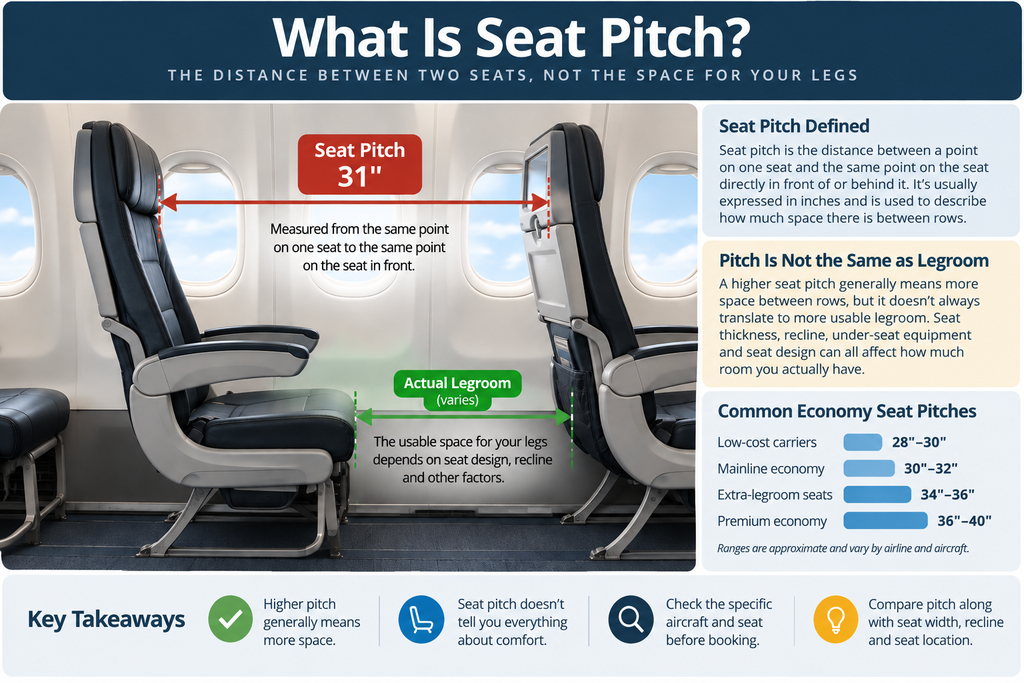
Imagine two rows of airplane seats. Instead of measuring from the edge of your seat to the seatback in front of you, seat pitch measures from a fixed point on one seat to the same point on the next seat.
For example:
Seat A → 31 inches → Seat B
That measurement is the seat pitch, and it gives airlines and passengers a standardized way to describe the spacing between rows.
Generally:
- Higher pitch = more space between rows
- Lower pitch = tighter seating configuration
However, that doesn’t necessarily mean every inch of additional pitch translates directly into another inch of usable knee room.
Seat Pitch vs. Legroom: What’s the Difference?
The terms are often used interchangeably, but they don’t technically describe the same thing.
- Seat pitch measures the distance between corresponding points on consecutive seats.
- Legroom describes the usable space available for your legs while sitting in the seat.
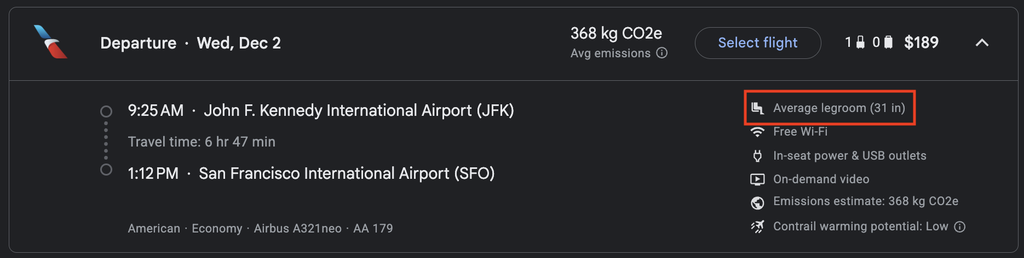
Google Flights often displays seat pitch as “average legroom.” For example, a flight may show “Average legroom (30 in).” That figure is useful for comparing flights, but it should not be interpreted as 30 inches of empty space in front of your knees. It generally reflects the spacing between seat rows.
Now imagine two airlines both advertise 31 inches of seat pitch. One airline uses older, thicker seats, while the other uses newer slimline seats with thinner seatbacks.
Even though the published pitch is identical, the second configuration could feel more spacious because the seat itself occupies less of the available area.
Seat pitch measures seat spacing. It doesn’t perfectly measure passenger space.
That’s why pitch is useful for comparison, but not definitive.
How Much Seat Pitch Do Economy Seats Have?
There’s no single standard across airlines or aircraft.
Economy cabins can vary based on the airline, aircraft type and even the specific configuration of the same aircraft.
This is also why checking only the aircraft model isn’t always enough.
A Boeing 777 operated by one airline can have a substantially different cabin layout from a Boeing 777 operated by another.
Even an individual airline can operate multiple configurations of the same aircraft. This is one reason aircraft type can matter when choosing a flight, although the airline’s specific cabin configuration matters just as much.
Seat pitch is therefore best treated as one piece of the cabin puzzle.
Why Do Airlines Use Different Seat Pitches?
Cabin space is extremely valuable. Airlines have a finite amount of space to be able to use and have to decide how to divide a fixed amount of space among hundreds of passengers.
Increasing the distance between rows can improve passenger comfort, but it can also reduce the number of rows that fit inside the aircraft.
Reducing pitch can potentially allow more seats to be installed.
This creates a basic trade-off between Passenger space ↔ Cabin capacity
Different airlines make different choices.
A full-service carrier may configure an aircraft differently from an ultra-low-cost carrier. An airline may also reserve additional space for extra-legroom economy sections while using tighter spacing elsewhere in the cabin.
This is part of the larger economics behind airline cabin design, and more importantly how airlines think about revenue management strategies.
Does One or Two Inches of Seat Pitch Really Matter?
Theoretically, it can.
Consider two otherwise similar economy seats:
Seat A: 29-inch pitch
Seat B: 32-inch pitch
Three inches might not sound dramatic on paper.
But airplane cabins operate within relatively small dimensions to begin with, so seemingly minor differences can become noticeable, especially for taller travelers or on longer flights.
The value of that space also depends on the trip.
An extra inch or two might matter relatively little on a one-hour flight. Comparatively, on an eight-hour overnight flight, you may care much more.
That’s where The Fare Theory’s usual principle applies:
Don’t evaluate an upgrade solely by its absolute price. Evaluate what you’re getting and how long you’ll actually use it.
The same principle becomes even more important when deciding whether premium economy is worth paying for on a longer trip.
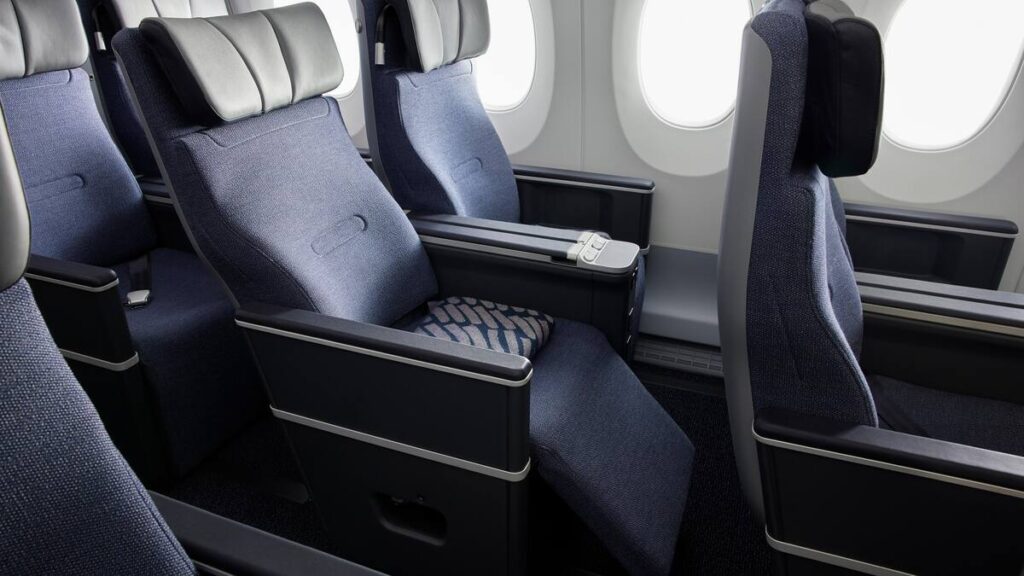
What About Extra-Legroom Economy Seats?
Many airlines sell seats that provide additional space while keeping you in the economy cabin.
Depending on the airline, these might be called:
- Economy Plus
- Main Cabin Extra
- Comfort+
- Economy Space
- Extra Legroom
- Preferred or stretch seating
But the terminology isn’t standardized.
More importantly, “preferred” doesn’t always mean “more legroom.” A preferred seat might simply have a more desirable location within the aircraft. An actual extra-legroom product usually increases the space between rows.
That means you should look at the seat specifications rather than relying solely on the airline’s marketing name.
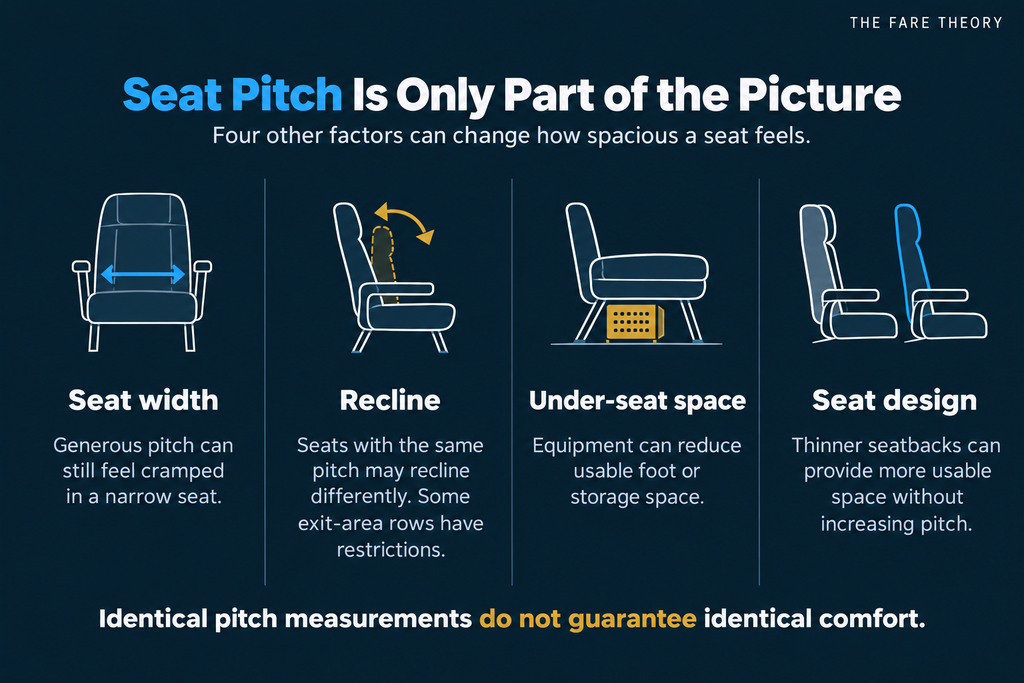
Seat Pitch Isn’t the Only Measurement That Matters
Pitch gets a lot of attention because it’s easy to compare, but there are several other characteristics worth checking.
Seat Width
Seat width measures the horizontal space available across the seat. A seat can have generous pitch while still feeling cramped if it’s particularly narrow.
Recline
Two seats with identical pitch may have different recline characteristics.
And some seats, particularly certain rows around emergency exits, may have restricted recline. Exit rows are a good example of why you shouldn’t evaluate a seat using pitch alone, because extra space can come with other trade-offs.
Under-Seat Space
Entertainment boxes, power equipment and structural components can sometimes reduce usable storage or foot space underneath the seat ahead.
Seat Design
Thinner seatbacks can create additional usable space without necessarily increasing the published pitch.
This is another reason two identical pitch measurements don’t guarantee identical experiences.
How to Check Seat Pitch Before Booking
Don’t wait until you’re sitting on the aircraft to figure out how much space you’re getting.
There are several ways to research the cabin beforehand.
- Start with the airline’s own aircraft and seat information when available.
- Then compare the aircraft configuration using a seat-map resource.
For example, SeatMaps can display information such as:
Pitch • Width • Recline • Seat location • Cabin configuration
That gives you considerably more context than simply seeing an available seat on the airline’s booking page. Our guide to using SeatMaps to choose an airline seat explains how to compare individual seats, cabin layouts and potential trade-offs before selecting one.
This is particularly useful when an airline operates several versions of the same aircraft.
What Seat Pitch Doesn’t Tell You
This is probably the biggest mistake travelers make with the measurement.
Suppose you’re comparing:
Flight A: 31-inch pitch
Flight B: 32-inch pitch
Flight B technically offers more pitch. But that doesn’t automatically make it the better flight.
Flight A could have:
- A wider seat
- Better padding
- More favorable under-seat space
- Better recline
- A more convenient schedule
- A better aircraft configuration
- A significantly lower fare
Meanwhile, Flight B’s extra inch may provide relatively little additional value to you.
Don’t optimize one measurement at the expense of the entire trip. That’s especially important when comparing flights that differ significantly in price.
Is Paying for More Seat Pitch Worth It?
This is where the question becomes less about seat specifications and more about value.
Imagine you’re choosing between:
Standard economy: 30-inch pitch
Extra-legroom economy: 34-inch pitch
Upgrade cost: $45
Is four additional inches worth $45? There’s no universal answer.
Instead, you should consider:
- Flight duration: How many hours will you use the extra space?
- Your height: Taller travelers may benefit considerably more.
- Seat location: Are you also getting a better position in the cabin?
- Restrictions: Does the seat have limited recline or unusual storage rules?
- Alternative seats: Could you get similar space from an exit row or another seat?
- Price: How much are you paying per hour for the improvement?
For a two-hour flight, if the incremental cost is $45, that’s about $22.50 per flight hour. Now if you consider a nine-hour flight at that same price, it’s effectively $5 per flight hour.
Same upgrade, but very different value proposition. This is similar to the framework behind our Upgrade Value Calculator, which looks at the cost of an upgrade relative to how long you’ll actually experience it.
Seat Pitch vs. Exit Row: Which Gives You More Space?
This comparison can be misleading. An exit row may provide substantially more usable space than a standard economy seat, but its characteristics vary by aircraft.
You may encounter more legroom, but potentially have a trade-off with some of these:
Limited recline • Different tray-table placement • Different storage rules • Eligibility requirements
So if your goal is simply maximizing legroom, don’t automatically choose the seat with the largest number you see. Look at the complete seat configuration.

Should Tall Travelers Prioritize Seat Pitch?
Seat pitch becomes increasingly relevant as your body requires more space between rows.
For a shorter traveler, the difference between 30 and 32 inches may be noticeable but relatively minor. However, for someone whose knees are already close to the seatback, those additional inches can have a much larger effect.
But tall travelers should still evaluate more than pitch.
A bulkhead or exit-row seat might provide dramatically different usable space, while certain under-seat obstructions can make an otherwise normal seat uncomfortable.
This is another reason researching the specific seat is more useful than researching only the airline.
The Fare Theory: Compare the Seat, Not Just the Number
Seat pitch gives you useful information, but it just doesn’t tell you everything. One should use it as one part of a larger comparison:
Pitch + width + recline + seat design + location + flight duration + price
A 32-inch seat isn’t automatically worth paying more for than a 30-inch seat. And two seats with identical pitch won’t necessarily provide identical comfort.
The goal isn’t to find the seat with the biggest number. It’s to understand what you’re actually getting for your money.
FAQ
What does 31-inch seat pitch mean?
A 31-inch seat pitch means there are 31 inches between a fixed point on one seat and the corresponding point on the seat directly ahead or behind it. It does not mean you have 31 inches of empty legroom.
Is seat pitch the same as legroom?
No. Seat pitch measures the spacing between consecutive seats, while legroom refers more generally to the usable space available for your legs.
Is higher seat pitch better?
Generally, greater pitch means more space between rows. However, seat thickness, width, recline, under-seat obstructions and cabin design can also affect comfort.
Does seat pitch vary by aircraft?
Yes. Pitch can vary between airlines, aircraft types, cabin classes and even different configurations of the same aircraft.
How can I find the seat pitch for my flight?
Check the operating airline’s aircraft information and then verify the specific configuration using a seat-map resource. Your exact aircraft can also change before departure.